Showing posts with label Akita. Show all posts

Monday, February 18, 2013

Ryuugakuchuu no baito? (A part time job while studying abroad?)

So, when I first started writing this blog I thought I would write about each trip I did, in its entirety. So I would only write posts about Japan, then only posts about Hawaii, etc. Lately I've been thinking that maybe that gets tedious for people, to only read about one place for so many posts. So I decided I am going to mix it up and start posting about my other experiences, as well as the rest of my Japan experiences. I'm also working on starting my Colorado spotlight, but it may be a while because a.) it's winter and b.) I am broke. But expect to see posts about my home state soon. Unfortunately, I don't have a post about something other than Japan written up yet, so until I do, please enjoy the following post about teaching English in Japan.


Most people when they study abroad tend to take it easy on any sort of responsibilities and focus only on having fun. While this is great, I was not so lax. Not only did my grades transfer directly back, requiring me to concentrate on school while having fun, I also picked up a part-time job. A student visa lets exchange students work for less than 20 hours. I was offered a position teaching English at an after-school program in Akita city. You might think I was hesitant to work, but in fact it was a great opportunity, a fun experience, and gave me a little extra spending money. What’s not to like?

I worked on Saturdays, and occasionally on Wednesdays if my recruiter, coworker, and fellow AIU student needed a shift covered. The first day I went into the city was to visit my new employer, with my friend to guide me. The drive there was lovely, as we passed seemingly endless rows of rice farms. Once we reached the city, however, I was a bit taken aback by the sudden urban scenery. Signs in half-familiar Japanese flanked me from all sides, with bright colors and cute mascots beckoning. Akita city is by no means a busy or crowded city, but it is still a stark contrast to the countryside of AIU.

The company I was to teach with was in a small building, surrounded by a sushi restaurant on one side, and a convenience store (konbini) across the street. When I walked in, I had to take off my shoes in the front area called a genkan. Japanese people are very particular about taking off shoes, and this is a distinct feature of Japanese homes. As silly as it may sound, I was delighted to be performing in this daily ritual of Japanese life. My boss was a Japanese man who had lived in the United States for much of his life. He didn’t need to give me a tour, because there was only one room, bisected by a tall book shelf. The décor was bright, cheerful, and very similar to any other elementary/middle school classroom. He gave me the textbook to take home and study, and told me what my students were like. He said that they were considered to be advanced for their age in the English language. With more than a little pride, he told me, “They are pretty smart.”

My second trip there was terrifying and great all at once. I had instructions from my friend on which buses to take, and where to get off, but I was very nervous. I gave myself a ridiculous amount of time to make sure I could make up for anything I might do wrong. Somehow I managed to get it all right, however I fumbled for a long time trying to count out the right change when I paid. I got a lot of awkward stares. (After that I would always have my fare ready and counted out.) Miraculously, I wasn’t late.

My first class was somewhat awkward. I had 3 students, two younger ones in late elementary who were brother and sister, and an older girl in middle school. They were all lovely, if a bit shy. I introduced myself, using my much practiced jikoshoukai (self-introduction). I asked them where they were in the book, and tested them a bit to get a grasp of their level. My understanding is that most Japanese students know how to read and write English fairly well, but can hardly speak or understand it. Thus I wanted to really focus on the oral part of the lesson. To get them used to hearing it, I would explain first in English, try my best to clarify in Japanese, and then repeat the explanation again in English. (My opinion is first-language support while learning in the lower levels of a second language is more effective than full immersion classes.) I also quizzed them in English. Luckily, they were fast learners and the awkwardness faded after a couple weeks.

Teaching them was a lot of fun, and I had the pleasure of teaching them a little about the United States, as well. I learned more about them and more about being a kid in Akita. On my last day with them, I bought them all cake to thank them for being so awesome. Before, I didn’t want to teach English in Japan, which is a common first career move for Japanese majors. This experience changed my mind. Now I am thinking that I might not just teach English in Japan, but maybe around the world! After all, I know from experience how crossing language barriers can help you cross country borders. J

Monday, January 28, 2013

Lake Tazawa and Lady Tatsuko

The second part of our first 3-part bus trip was an interesting study in contrasts. Our trip had actually started with a short stop at a cherry-blossom lined valley, where we bought snacks, took pictures, soaked in the sunlight, and distracted a large group of elderly people playing croquet. After going from that to the beautiful river, still bathed in sunshine, I thought for a while that the sun would stay all day. It didn't. And while the lake we traveled to next, called Lake Tazawa, was beautiful and interesting as a tourist, I was dismayed at the grey clouds which erased all the color that had dazzled me just an hour earlier. Such is early spring in Japan, I suppose.
(The beautiful sunny beginning of the day.)

Lake Tazawa has many claims to fame. First of all, it is the deepest lake in Japan. It's maximum depth is 423 meters, or roughly 1388 feet, and because of its depth it never freezes (Wikipedia.org). It's depth also causes the water to be a beautiful, rich blue color. It is flanked by Japan's largest ski resort, Tazawa Ski Area, as well as several famous onsen, or hot springs (Wikipedia.org).

It is also famous for the golden statue of a beautiful woman, named Tatsuko. The legend surrounding this statue says that Tatsuko was a woman of great beauty. Fearing the fleeting nature of such beauty, Tatsuko prayed at a shrine for 100 nights that her good looks would remain. On the last night, she received a message to drink from a holy spring. Perhaps because of her vanity, instead of granting her everlasting beauty, the drink turned her into a guardian dragon to watch over the lake (Oh Tazawako Blog). However, maybe in the end she received her wish, now that her image has been immortalized in the form of the gold statue, made by Yasutake Funakoshi in 1968 (semboku.akita.jp).

(The Golden Tatsuko. This picture belongs to a friend of mine.)


If you were to google image search Lake Tazawa, you would find hundreds of beautiful landscapes, with clear skies, deep blue water, bright white boats, and the golden charm of Tatsuko. Unfortunately, as I mentioned above, by the time we got there it was cold and grey. Although the lake was still beautiful, it was mostly due to the fact that nature can never really be plain. As such, my pictures are all quite monochromatic.

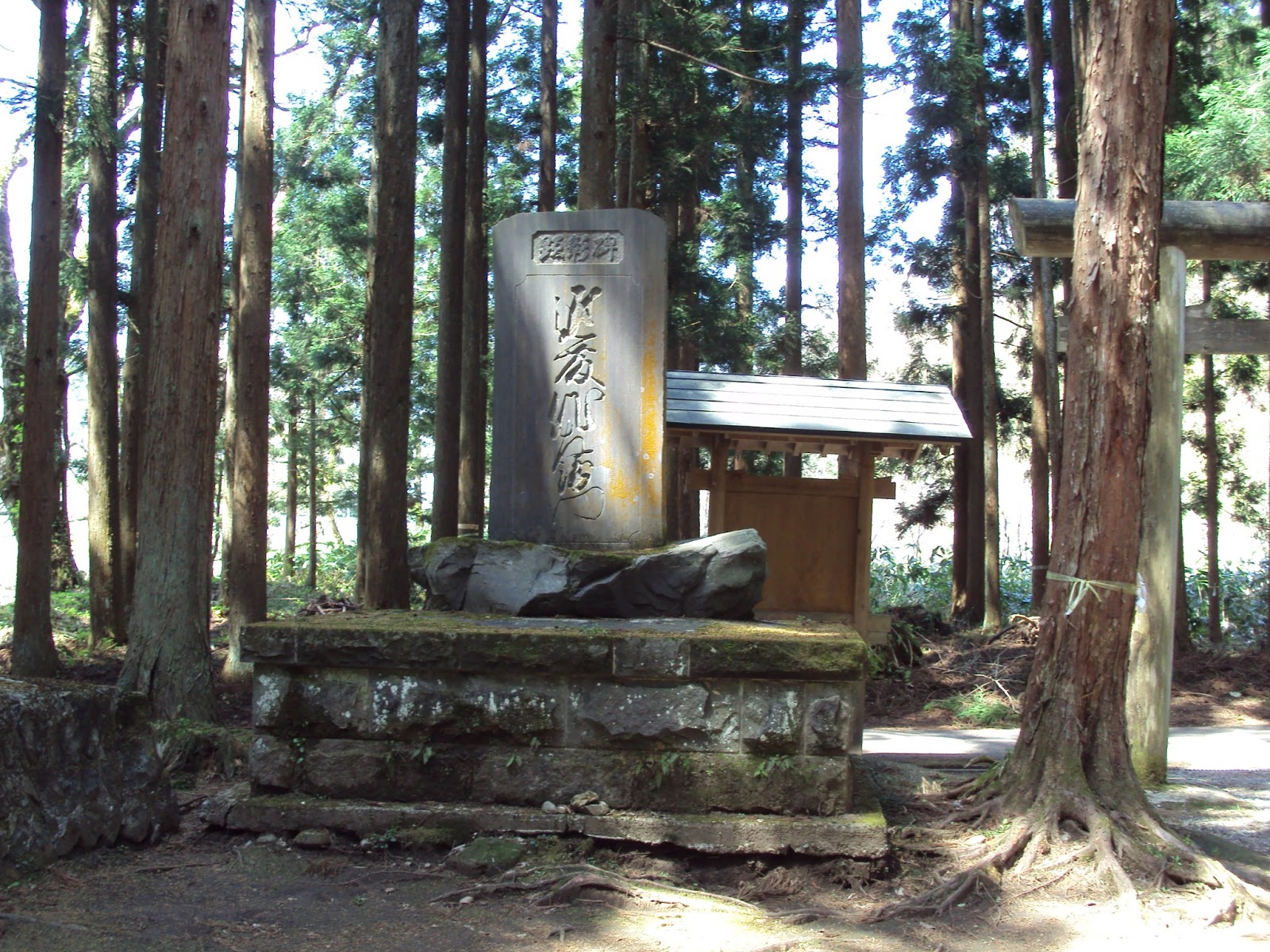
Our time was short. As we filed out of the bus, we were all handed a prepackaged bento, or boxed lunch. These were actually quite tasty, consisting of rice, Japanese pickles, fried potato dumplings, noodle salad, hamburger patties, fried chicken pieces, and fruit. As we munched, we gazed out at the mountains hovering over the expansive lake. Close by was a small shrine, flanked by beautiful stone lanterns decorated by engraved kanji characters, as well as two stone lion guardians. Many people bought fortunes printed out on thin strips of paper called omikuji. Tradition grants people a fail-safe against bad or bland fortunes, by allowing them to tie the strips of paper to near-by ropes. This is supposed to erase bad luck, and create a blank slate for another chance at good luck (Wikipedia.org).

(The shrine at Lake Tozawa. You can see the stone lantern in front there, just on the sand.)

(A close up to show you the kanji inscribed in the lantern.)

(The stone lion guarding the shrine.)

(The numerous  fortunes bought and tied at the shrine for better luck.)

Having finished our meals, Justin and I went to greet the golden Tatsuko, and had our picture taken beside her. Reaching her required a bit of dexterity, as we crossed over jagged and wet rocks. I think perhaps you cannot reach her if the tide is high. Thinking back now, I hope we didn't commit a culture faux pas by going all the way out to her.

(Me and Justin beside the beautiful Tatsuko.)


When we loaded back on to the bus, I think we spent a mere 45 minutes at Lake Tazawa. Someday, I hope to return on a nicer day. They offer boat trips, which sound lovely, and I wouldn't mind going to one of the onsen or the ski resort to gaze down at the beautiful, deep blue that Tatsuko calls her home.  

Sunday, January 20, 2013

Blue River and Roaring Waterfall

We have come now to a post that I have been dreaming of and dreading since I first got the idea for this blog. While I treasure nearly every experience I had in Japan, there are a few that rank in my absolute favorites, and the first AIU bus trip is one of them. I have been excited to tell everyone about the beautiful places I visited, but also worried about accurately portraying how amazing it all was. I cannot delay the plunge forever, though, so here it goes.

AIU does something that I wish every university, college, and high school did: they organized field trips. Who doesn’t love a good field trip? Why don’t teachers do this more often? Because AIU was so invested in the international experience, part of our tuition money went towards bus trips during which the school took you to various tourist locations in Akita prefecture. Unfortunately for us, these outings, which were usually numerous, had either been cancelled or squished down to a meager two trips. This was due to fear of the frequent aftershocks from the big earthquake. Still, each trip was filled to the brim with fun, and although they were much too short, I was grateful to be on them at all.

The first trip consisted of three parts. The first of those parts was a visit to a Shinto shrine near a staggeringly beautiful river fed by a roaring waterfall. This excursion was the first thing I had really “seen” in Japan, and it left me with a sublime feeling I have yet to encounter since. The day was starting out perfect, with the first sunny, blue sky since we had landed. When the bus pulled up, we were all let out and set free to roam and explore. Before us lay a stretch of grasses, leading up to a mostly obscured river between two wooded hills, crossed by a bright red suspension bridge. Although the landscape was touched here and there with splashes of bright green, over all the colors were muted browns and pine greens, for it was still early spring. Northern Japan, like Colorado, wakes from winter slowly. Most people headed for the most noticeable landmark, an island-like precipice rising from the bank, topped by a few trees and a shrine marker. Justin and I made our way to the main shrine, into the pine trees toward a trail that wound up the side of the hills.


As we crept through the torii, or the gate of the shrine, a feeling of blissful calm settled over us. Justin and I said little, content to soak in the warmth of the sunlight, and watch as the rays burst through the trees to dapple the ground. Many people went up to the shrine bell to ring it and perform the claps and prayers of Shinto tradition. I wanted to, but we hesitated. We were unsure of whether we should partake for the sake of the experience, or hold back because neither of us actually believed in the Shinto religion. Out of respect, we chose instead to wash our hands with the basin provided, admire the bell, but move on.


(The little basin where you wash your hands and rinse your mouth to purify yourself.)


(A signpost at the shrine).


The path along the hills was actually quite green. Below us, we could finally see the river clearly, and I was startled by its beautiful and rich blue color. At times deep cobalt, at others bright aquamarine, I wondered at the mineral in the water that must turn it such a perfect shade. Understandably, I took many pictures, and some of my best work was found on this walk.

(The beautiful blue of the water. I wonder what makes it so blue, and so milky.)


The path was just as beautiful as the water. Every bend seemed to offer up a new gem of natural beauty. At one turn there was a small cave surrounded by new spring leaves. Justin and I crossed the suspension bridge, delighting in the bounce it gave to our steps. On the other side, there was a natural bowl-like groove in the stone that had filled with water, and someone had put a ladle there for drinking. The water was cold and clean and pure in taste. A cacophony of rapids sang below us. New tree leaves hovered silently in the golden air like sprites. Little springs trickled down the sides, teasing at the great spectacle waiting for us at the end.

(The little cave along the pathway.)


(Turquoise rapids.)

(A little spring falling down the mountain side, bathed in a column of light.)

For the most part, we had meandered down the path at our leisure, but then suddenly people were running past us in the opposite direction. Finally, someone paused to inform us that it was time to go, but that there was an awesome waterfall up ahead. “If you run, you can make it.” Not caring for the odd looks from other visitors, we instantly broke into a run, praying we would find this waterfall before we were dragged back. We made it. Although we were out of breath, it was so worth it.

(Roar, baby, roar!)


The photo above does not communicate how big and grand the waterfall was. Its powerful waters broke against the rocks and threw a cool spray over its spectators. Surely this lord of water was the inspiration for the shrine. Its proud turbulence belied the peaceful ascent we had taken to reach it. Thoroughly pleased, we turned back to that tranquil path, before boarding the bus once again, ready for the next stretch of our trip.

It may seem strange that such an uneventful experience could be among my most favorite memories of Japan. After all, we didn’t really do much at this river. But the scene was so picturesque, the shrine was so peaceful, and the waterfall was so amazing, that it has come to embody the essential beauty of Japan in my heart. Although I do not practice Shinto, I can understand why one would find such a perfect place worth worshiping. 

Sunday, January 13, 2013

My Host Family


Many people who study abroad, especially high school students, usually do so while staying with a host family. I've always been a little jealous of these people. It sounds so cool to go home every day to a family who is delighted to have you and your foreign-ness there. Plus you have people who are actively invested in your study abroad experience, as opposed to being entirely responsible for your own experience. As you know, I stayed in the dorms during my study abroad. Of course, I had my roommate, Mai, there to hang out with every night, but, being a student herself, she never felt really responsible for the experience I was having.

However, just because I stayed in the dorm does not mean I lacked a host family. In fact, AIU had a host-family system set up, where you signed up and they matched you with a family who had also signed up. I immediately put my name on the list, noting that I didn't mind if they only spoke Japanese. (My Japanese is pretty good.) This program was on a first come first serve basis, but I think because the earthquake had reduced the number of exchange students severely, everyone who signed up got matched up. Justin, being shy, did not sign up, but luckily my host family adopted him with open arms.

The experience of having a host family varied between students. I had one friend who did a lot of fun things with her host family, but she said it was awkward because she spoke no Japanese, and they spoke no English. Sadly, a few people were never even contacted by their host families. Fortunately, I could not have imagined a better host family for me and Justin.

Our host family consisted of an 8 year old girl, Miu, and her parents, whom we called “Miu-Mama” and “Miu-Papa.” On our first visit, merely a preliminary interview-style meeting, they eagerly asked us where we wanted to go and what we wanted to do. They spoke no English, and although my Japanese skills were meager at first, they were patient and easy to talk to, and over our subsequent visits my language abilities increased substantially. Justin and I first just wanted to get to know them, and so we proposed a meal together. It was determined that we should eat the local Akita specialty, a dish called kiritanpo, at their house.

Kiritanpo are rice dumplings made by pounding cooked rice until lightly mashed, and then molding it around a wooden skewer and cooking it over an open flame or grill. These can be served on their own, or are commonly added to a stew along with vegetables like cabbage and carrots, as well as chicken. This country meal is very popular and famous in Akita, and you can find prepackaged kiritanpo to send to your relatives at nearly every tourist attraction in the prefecture. Despite the fact that it was already quite warm in Japan, Miu-Mama happily agreed to make the dish. At my request, she even cut off the chicken skin that seems to plague all supermarket chicken in Japan.

(An assembled kiritanpo hot pot. The white tubes in the middle are the kiritanpo. This is a public use photo.)


On the day of our first real visit, our host family picked us up in the tiny parking lot at AIU. There they met my roommate, and I secretly relished in watching their very Japanese introductions, with all the bowing and the “hajimemashite” (nice to meet you) phrasing that I practiced for hours in first-semester Japanese class. Justin and I got into the backseat of the car with Miu, to discover they had brought along their adorable miniature poodle named Mocha (for his coffee coloring). To my delight, he instantly curled up on my lap.

Our host-family’s house was gorgeously clean and simply decorated. It was quite big for a Japanese house, but that was to be expected in a country-town like Akita. Miu showed us her room with childish enthusiasm, and then Miu-Mama brought out a plate with cheese and crackers, as well as a platter of expensive cookies. (Japanese people often buy pricey cookies and hors d’oeuvres for the sole purpose of hosting guests). Then, while the kiritanpo cooked, we played Wii bowling and Justin showed Miu a rhythm game on her Nintendo DS called Ouendan (which is very fun and highly recommended). Miu instantly became a wiz at it, and could barely tear herself away to eat.

Joining us to eat was a family friend who quickly became another member of our host family, the beautiful Nepalese Rashmin and her adorable, 2 year old, half-Japanese daughter, Koena. Rashmin was a welcome addition, not only because she was friendly, but also because she spoke English and could help me with phrases I didn’t know how to say in Japanese. Together, we sat down and chatted over our kiritanpo, which was warm and delicious. I loved the texture of the rice dumplings soaked in broth. Miu-Mama and Miu-Papa told us about their jobs, and Miu told us about school. Justin and I talked about AIU, traveling after the earthquake, and the United States. We all cooed over Koena, especially whenever she tried to do the hand-sign for peace, a beloved gesture in Japan and absolutely necessary in any photos. Koena knew to do it whenever a photo was taken, but she could only hold up her thump and first finger. Her utter confidence in the gesture made us giggle every time. The whole scene was simultaneously ordinary and exhilarating. I felt like I lived there, and the day seemed much too short when we finally were driven home, with promises to meet up again soon.
(Me, Justin, Miu, and little Koena. You can see her here trying to make a peace sign. <3 )

In various subsequent posts, you’ll read about more meet-ups I had with my host family. Each visit is a cherished memory, and I feel uncommon warmth whenever I think of them. I hope to stay in touch with them, though I have been quite terrible at it so far. Life gets in the way, but I really want to maintain our friendship. I know that they added richness and delight to my trip abroad, and I hope that Justin and I returned some of it. Japan can seem a very unwelcoming place to foreigners, especially in the countryside where many people have never seen a non-Asian face. However, Miu and her parents proved that there are some who will welcome new people and new cultures with smiles, and believe the exchange to be an act of both giving and receiving. I think that eager openness is at the heart of traveling, and what I think AIU strives to embody and promote. 
(All of us around the delicious kiritanpo. Miu-Mama is holding Koena.)