The second part of our first 3-part bus
trip was an interesting study in contrasts. Our trip had actually
started with a short stop at a cherry-blossom lined valley, where we
bought snacks, took pictures, soaked in the sunlight, and distracted
a large group of elderly people playing croquet. After going from
that to the beautiful river, still bathed in sunshine, I thought for
a while that the sun would stay all day. It didn't. And while the
lake we traveled to next, called Lake Tazawa, was beautiful and
interesting as a tourist, I was dismayed at the grey clouds which
erased all the color that had dazzled me just an hour earlier. Such
is early spring in Japan, I suppose.
(The beautiful sunny beginning of the day.)
Lake Tazawa has many claims to fame.
First of all, it is the deepest lake in Japan. It's maximum depth is
423 meters, or roughly 1388 feet, and because of its depth it never
freezes (Wikipedia.org). It's depth also causes the water to be a
beautiful, rich blue color. It is flanked by Japan's largest ski
resort, Tazawa Ski Area, as well as several famous onsen,
or hot springs (Wikipedia.org).
It is also famous
for the golden statue of a beautiful woman, named Tatsuko. The legend
surrounding this statue says that Tatsuko was a woman of great
beauty. Fearing the fleeting nature of such beauty, Tatsuko prayed at
a shrine for 100 nights that her good looks would remain. On the last
night, she received a message to drink from a holy spring. Perhaps
because of her vanity, instead of granting her everlasting beauty,
the drink turned her into a guardian dragon to watch over the lake
(Oh Tazawako Blog). However, maybe in the end she received her wish,
now that her image has been immortalized in the form of the gold
statue, made by Yasutake Funakoshi in 1968 (semboku.akita.jp).
(The Golden Tatsuko. This picture belongs to a friend of mine.)
If you were to
google image search Lake Tazawa, you would find hundreds of beautiful
landscapes, with clear skies, deep blue water, bright white boats,
and the golden charm of Tatsuko. Unfortunately, as I mentioned above,
by the time we got there it was cold and grey. Although the lake was
still beautiful, it was mostly due to the fact that nature can never
really be plain. As such, my pictures are all quite monochromatic.
Our
time was short. As we filed out of the bus, we were all handed a
prepackaged bento, or
boxed lunch. These were actually quite tasty, consisting of rice,
Japanese pickles, fried potato dumplings, noodle salad, hamburger
patties, fried chicken pieces, and fruit. As we munched, we gazed out
at the mountains hovering over the expansive lake. Close by was a
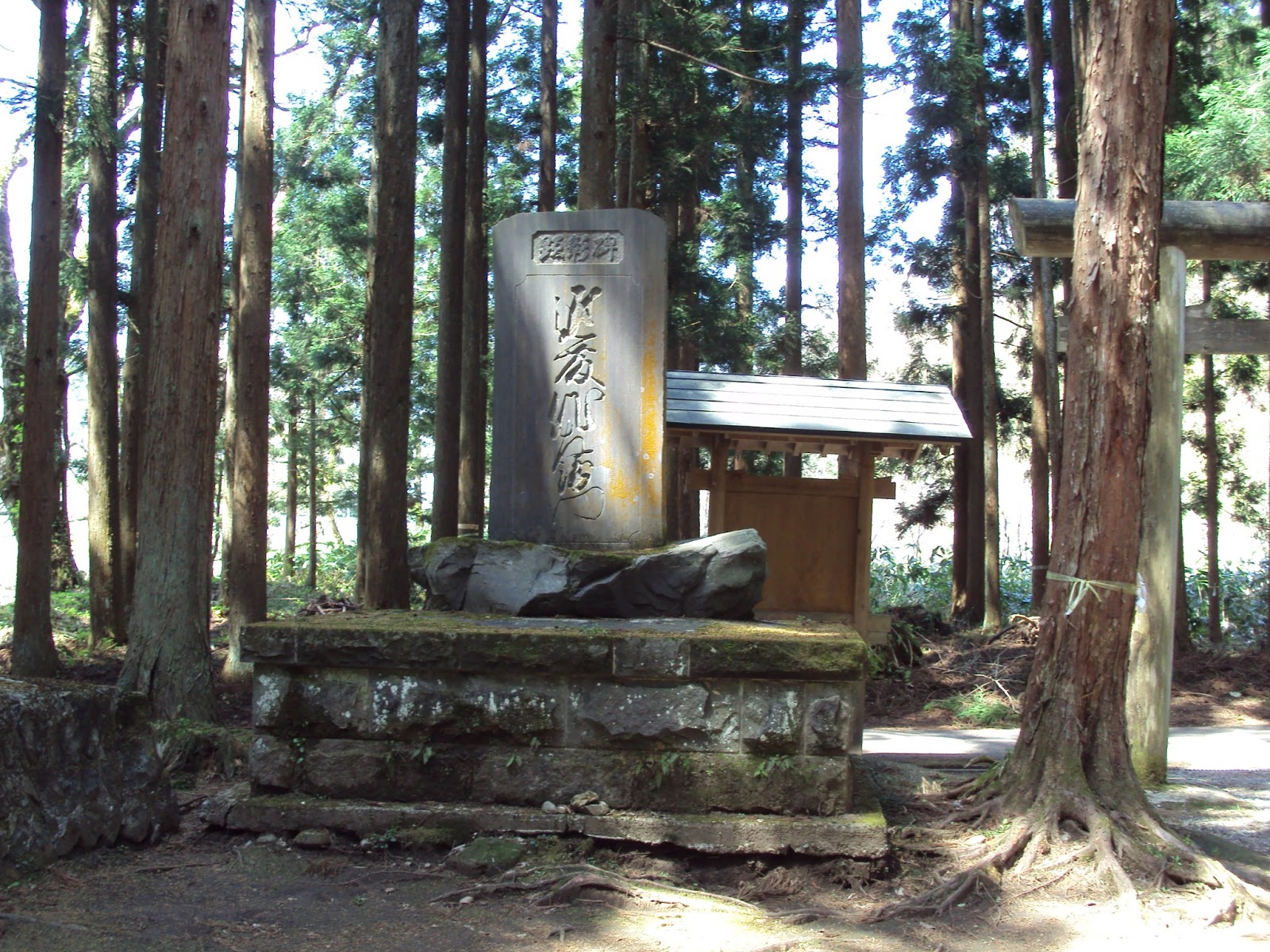
small shrine, flanked by beautiful stone lanterns decorated by
engraved kanji
characters, as well as two stone lion guardians. Many people bought
fortunes printed out on thin strips of paper called omikuji.
Tradition grants people a fail-safe against bad or bland fortunes, by
allowing them to tie the strips of paper to near-by ropes. This is
supposed to erase bad luck, and create a blank slate for another
chance at good luck (Wikipedia.org).
(The shrine at Lake Tozawa. You can see the stone lantern in front there, just on the sand.)
(A close up to show you the kanji inscribed in the lantern.)
(The stone lion guarding the shrine.)
(The numerous fortunes bought and tied at the shrine for better luck.)
Having finished our
meals, Justin and I went to greet the golden Tatsuko, and had our
picture taken beside her. Reaching her required a bit of dexterity,
as we crossed over jagged and wet rocks. I think perhaps you cannot
reach her if the tide is high. Thinking back now, I hope we didn't
commit a culture faux pas by going all the way out to her.
(Me and Justin beside the beautiful Tatsuko.)
When we loaded back
on to the bus, I think we spent a mere 45 minutes at Lake Tazawa.
Someday, I hope to return on a nicer day. They offer boat trips,
which sound lovely, and I wouldn't mind going to one of the onsen or
the ski resort to gaze down at the beautiful, deep blue that Tatsuko
calls her home.
We have come now to a post that I have been dreaming of and
dreading since I first got the idea for this blog. While I treasure nearly
every experience I had in Japan, there are a few that rank in my absolute
favorites, and the first AIU bus trip is one of them. I have been excited to
tell everyone about the beautiful places I visited, but also worried about accurately
portraying how amazing it all was. I cannot delay the plunge forever, though,
so here it goes.
AIU does something that I wish every university, college,
and high school did: they organized field trips. Who doesn’t love a good field
trip? Why don’t teachers do this more often? Because AIU was so invested in the
international experience, part of our tuition money went towards bus trips
during which the school took you to various tourist locations in Akita
prefecture. Unfortunately for us, these outings, which were usually numerous,
had either been cancelled or squished down to a meager two trips. This was due
to fear of the frequent aftershocks from the big earthquake. Still, each trip
was filled to the brim with fun, and although they were much too short, I was
grateful to be on them at all.
The first trip consisted of three parts. The first of those
parts was a visit to a Shinto shrine near a staggeringly beautiful river fed by
a roaring waterfall. This excursion was the first thing I had really “seen” in
Japan, and it left me with a sublime feeling I have yet to encounter since. The
day was starting out perfect, with the first sunny, blue sky since we had
landed. When the bus pulled up, we were all let out and set free to roam and
explore. Before us lay a stretch of grasses, leading up to a mostly obscured
river between two wooded hills, crossed by a bright red suspension bridge.
Although the landscape was touched here and there with splashes of bright
green, over all the colors were muted browns and pine greens, for it was still
early spring. Northern Japan, like Colorado, wakes from winter slowly. Most
people headed for the most noticeable landmark, an island-like precipice rising
from the bank, topped by a few trees and a shrine marker. Justin and I made our
way to the main shrine, into the pine trees toward a trail that wound up the
side of the hills.
As we crept through the torii,
or the gate of the shrine, a feeling of blissful calm settled over us. Justin
and I said little, content to soak in the warmth of the sunlight, and watch as
the rays burst through the trees to dapple the ground. Many people went up to
the shrine bell to ring it and perform the claps and prayers of Shinto
tradition. I wanted to, but we hesitated. We were unsure of whether we should
partake for the sake of the experience, or hold back because neither of us
actually believed in the Shinto religion. Out of respect, we chose instead to
wash our hands with the basin provided, admire the bell, but move on.
(The little basin where you wash your hands and rinse your mouth to purify yourself.)
(A signpost at the shrine).
The path along the hills was actually quite green. Below us,
we could finally see the river clearly, and I was startled by its beautiful and
rich blue color. At times deep cobalt, at others bright aquamarine, I wondered
at the mineral in the water that must turn it such a perfect shade.
Understandably, I took many pictures, and some of my best work was found on
this walk.
(The beautiful blue of the water. I wonder what makes it so blue, and so milky.)
The path was just as beautiful as the water. Every bend
seemed to offer up a new gem of natural beauty. At one turn there was a small
cave surrounded by new spring leaves. Justin and I crossed the suspension
bridge, delighting in the bounce it gave to our steps. On the other side, there
was a natural bowl-like groove in the stone that had filled with water, and
someone had put a ladle there for drinking. The water was cold and clean and
pure in taste. A cacophony of rapids sang below us. New tree leaves hovered
silently in the golden air like sprites. Little springs trickled down the
sides, teasing at the great spectacle waiting for us at the end.
(The little cave along the pathway.)
(Turquoise rapids.)
(A little spring falling down the mountain side, bathed in a column of light.)
For the most part, we had meandered down the path at our
leisure, but then suddenly people were running past us in the opposite
direction. Finally, someone paused to inform us that it was time to go, but
that there was an awesome waterfall up ahead. “If you run, you can make it.”
Not caring for the odd looks from other visitors, we instantly broke into a
run, praying we would find this waterfall before we were dragged back. We made
it. Although we were out of breath, it was so worth it.
(Roar, baby, roar!)
The photo above does not communicate how big and grand the
waterfall was. Its powerful waters broke against the rocks and threw a cool
spray over its spectators. Surely this lord of water was the inspiration for
the shrine. Its proud turbulence belied the peaceful ascent we had taken to
reach it. Thoroughly pleased, we turned back to that tranquil path, before
boarding the bus once again, ready for the next stretch of our trip.
It may seem strange that such an uneventful experience could
be among my most favorite memories of Japan. After all, we didn’t really do much at this river. But the scene was
so picturesque, the shrine was so peaceful, and the waterfall was so amazing,
that it has come to embody the essential beauty of Japan in my heart. Although
I do not practice Shinto, I can understand why one would find such a perfect
place worth worshiping.
Many people who study abroad, especially high school
students, usually do so while staying with a host family. I've always been a
little jealous of these people. It sounds so cool to go home every day to a
family who is delighted to have you and your foreign-ness there. Plus you have
people who are actively invested in your study abroad experience, as opposed to
being entirely responsible for your own experience. As you know, I stayed in
the dorms during my study abroad. Of course, I had my roommate, Mai, there to hang
out with every night, but, being a student herself, she never felt really
responsible for the experience I was having.
However, just because I stayed in the dorm does not mean I
lacked a host family. In fact, AIU had a host-family system set up, where you
signed up and they matched you with a family who had also signed up. I
immediately put my name on the list, noting that I didn't mind if they only
spoke Japanese. (My Japanese is pretty good.) This program was on a first come
first serve basis, but I think because the earthquake had reduced the number of
exchange students severely, everyone who signed up got matched up. Justin,
being shy, did not sign up, but luckily my host family adopted him with open
arms.
The experience of having a host family varied between
students. I had one friend who did a lot of fun things with her host family,
but she said it was awkward because she spoke no Japanese, and they spoke no
English. Sadly, a few people were never even contacted by their host families.
Fortunately, I could not have imagined a better host family for me and Justin.
Our host family consisted of an 8 year old girl, Miu, and
her parents, whom we called “Miu-Mama” and “Miu-Papa.” On our first visit,
merely a preliminary interview-style meeting, they eagerly asked us where we
wanted to go and what we wanted to do. They spoke no English, and although my
Japanese skills were meager at first, they were patient and easy to talk to,
and over our subsequent visits my language abilities increased substantially.
Justin and I first just wanted to get to know them, and so we proposed a meal
together. It was determined that we should eat the local Akita specialty, a
dish called kiritanpo, at their
house.
Kiritanpo are rice
dumplings made by pounding cooked rice until lightly mashed, and then molding
it around a wooden skewer and cooking it over an open flame or grill. These can
be served on their own, or are commonly added to a stew along with vegetables
like cabbage and carrots, as well as chicken. This country meal is very popular
and famous in Akita, and you can find prepackaged kiritanpo to send to your
relatives at nearly every tourist attraction in the prefecture. Despite the
fact that it was already quite warm in Japan, Miu-Mama happily agreed to make
the dish. At my request, she even cut off the chicken skin that seems to plague
all supermarket chicken in Japan.
(An assembled kiritanpo hot pot. The white tubes in the middle are the kiritanpo. This is a public use photo.)
On the day of our first real visit, our host family picked
us up in the tiny parking lot at AIU. There they met my roommate, and I
secretly relished in watching their very Japanese introductions, with all the
bowing and the “hajimemashite” (nice
to meet you) phrasing that I practiced for hours in first-semester Japanese
class. Justin and I got into the backseat of the car with Miu, to discover they
had brought along their adorable miniature poodle named Mocha (for his coffee
coloring). To my delight, he instantly curled up on my lap.
Our host-family’s house was gorgeously clean and simply
decorated. It was quite big for a Japanese house, but that was to be expected
in a country-town like Akita. Miu showed us her room with childish enthusiasm,
and then Miu-Mama brought out a plate with cheese and crackers, as well as a
platter of expensive cookies. (Japanese people often buy pricey cookies and
hors d’oeuvres for the sole purpose of hosting guests). Then, while the kiritanpo cooked, we played Wii bowling
and Justin showed Miu a rhythm game on her Nintendo DS called Ouendan (which is very fun and highly
recommended). Miu instantly became a wiz at it, and could barely tear herself
away to eat.
Joining us to eat was a family friend who quickly became
another member of our host family, the beautiful Nepalese Rashmin and her
adorable, 2 year old, half-Japanese daughter, Koena. Rashmin was a welcome
addition, not only because she was friendly, but also because she spoke English
and could help me with phrases I didn’t know how to say in Japanese. Together,
we sat down and chatted over our kiritanpo,
which was warm and delicious. I loved the texture of the rice dumplings soaked
in broth. Miu-Mama and Miu-Papa told us about their jobs, and Miu told us about
school. Justin and I talked about AIU, traveling after the earthquake, and the
United States. We all cooed over Koena, especially whenever she tried to do the
hand-sign for peace, a beloved gesture in Japan and absolutely necessary in any
photos. Koena knew to do it whenever a photo was taken, but she could only hold
up her thump and first finger. Her utter confidence in the gesture made us
giggle every time. The whole scene was simultaneously ordinary and
exhilarating. I felt like I lived there, and the day seemed much too short when
we finally were driven home, with promises to meet up again soon.
(Me, Justin, Miu, and little Koena. You can see her here trying to make a peace sign. <3 )
In various subsequent posts, you’ll read about more meet-ups
I had with my host family. Each visit is a cherished memory, and I feel
uncommon warmth whenever I think of them. I hope to stay in touch with them,
though I have been quite terrible at it so far. Life gets in the way, but I
really want to maintain our friendship. I know that they added richness and
delight to my trip abroad, and I hope that Justin and I returned some of it.
Japan can seem a very unwelcoming place to foreigners, especially in the
countryside where many people have never seen a non-Asian face. However, Miu
and her parents proved that there are some who will welcome new people and new
cultures with smiles, and believe the exchange to be an act of both giving and
receiving. I think that eager openness is at the heart of traveling, and what I
think AIU strives to embody and promote.
(All of us around the delicious kiritanpo. Miu-Mama is holding Koena.)
Hello, my long awaiting readers (though you may be few).
After a terribly long absence, I am finally back, with a new blog post. First,
I would like to apologize for the delay. I know that, personally, it drives me
crazy when a favorite blogger or comic artist suddenly disappears and doesn’t
post anything new for months or sometimes years. I never wanted to be that
person, but in the end my personal life just became too overwhelming to
maintain posts. Of course there was university, but there was also the stress
of a new job, as well as my boyfriend’s hip surgery, which rendered him
completely helpless for a long time. A few other incidental stresses worked
together with these major ones to sap not only my motivation to write, but
also, quite honestly, my happiness. Only recently have I overcome a bout of
mild depression, and I am trying my best to keep up my spirits. I really think
devoting myself again to this blog will help. Writing has always been a sweet
escape from the stresses of daily life, but reminiscing about fun times abroad
is also a nice reminder that I have a good life worth appreciating.
So without further ado, I would like to return you to the
tales of my trip to Japan, to talk about one of my favorite Japanese cultural
traits: matsuri, or festivals. Japan
is really a country of festivals. There are so many, that it would be
impossible to count. The most common kind of festival is the kind often seen in
anime shows. These are local festivals that celebrate some deity or another,
and usually include cordoned off streets filled with stalls selling everything
from finger foods to masks and fans. There are also often carnival-style games,
floats, and street performers. In a later post, I will describe my own experience
with such a celebration.
Some festivals are
celebrated nation-wide, such as Obon,
a festival for one’s ancestors, Tanabata,
a wish-making festival, or kodomo no hi,
a celebration of children. In some regions the dates and various traditions of
these festivals vary, but they are all observed with at least a few similar
customs. During Obon, family gets
together to share in a feast and remember relatives, as well as visit family
graves and place food before the stones, which are often pretty sculptures made
of sugar. There is also usually a dance, which varies by region, to honor the
dead. At the end, paper lanterns are floated down rivers to carry the spirits
back to the realm of the dead. (Wikipedia.org).
Tanabata is a
festival which celebrates the meeting of two lover deities, Orihime and
Hikoboshi, embodied in two constellations, which are, in the West, Vega and
Altair, respectively (Wikipedia.org). These two lovers are only able to meet
once a year because of the distance separating them in the sky. During this
meeting, people write wishes to the gods on pieces of paper and then hang them
from a strip of bamboo (Wikipedia.org).
Kodomo no hi, or
children’s day, is exactly what it sounds like: a day to celebrate children.
The tradition is to raising carp-shaped flags called koi no bori, one for each child. The different colors and sizes
designate age. Originally, this day was only for boys, and only the male
children were celebrated, but it was changed in 1948 and was deemed to
celebrate all children. However, the festival remains mostly geared towards
boys (Wikipedia.org).
Luckily, girls get their festival, as well. This festival,
called hina matsuri, was the first
festival I encountered in Japan. Hina
matsuri translates into “doll festival.” The origins behind this festival
stem from the belief that dolls contained real spirits, which could turn
malignant if not respected (Wikipedia.org). To this day, many Japanese people
carry the suspicion that dolls having feelings and must not be insulted. However, the main purpose of the holiday is to
display a specific set of dolls and admire their beauty. The dolls depict an
emperor and empress, as well as their entourage, including ladies-in-waiting,
guards, musicians, and even their luggage and pack animal. These dolls are set
out in a specific order on a stepped platform covered in red cloth. A complete
set is often very expensive, and is usually a family heirloom, passed on from mother
to daughter. (If any of you have seen the original seasons of Pokemon, these
dolls are the dolls that Misty and Jesse compete to win in a particular battle
competition.)
AIU had a set of dolls displayed in a special tatami room.
People were welcome to come and look at it, though at the time I was still new
to the school and too timid to inspect the dolls closely. Fortunately, when I
went to go look with a friend, some school officials and the lady who had
generously lent AIU the dolls were preparing to pack them up (the festival was
at an end). They invited me and my friend to help put them away, and allowed me
to take a few pictures before they went back to sleep in their boxes.
I was most struck by the amazing attention to detail that
went into the dolls. As you can see in the photos, the clothes are absolutely
gorgeous, with tiny details that seem like whispers from a bygone age of
craftsmanship. The tea-set is so detailed that the whisk for the matcha powder
looks practically usable. I wasn’t sure what I expected the dolls to be made of
(perhaps porcelain) but they were actually made of high quality plastic, which
made them feel so light and delicate in my hands. The set even included two
trees, as well as two cherry blossom-print lanterns which would turn on if
plugged in. I felt so lucky to have the chance to handle the dolls and
appreciate them up close, and I have since become determined to own a set
myself someday. I will celebrate this beautiful matsuri with my future daughter.
(The Emperor in his regal kimono. I love the pattern on his kimono and also his hat.)
(The Empress with her delicately painted fan. This fan was only a bit bigger than a quarter, and yet not a line on that heron is misplaced.)
(One of the royal attendants. This one is in a sitting pose, cradling a small stand with two tea cups.)
(The royal tea set, complete with hot water in the center, a ladle on the right, and a tiny whisk on the left.)
I was delighted to have experienced this festival, as well
as a few others, during my stay in Japan. If you are interested in catching a
few festivals yourself, I recommend traveling to Japan during the summer
months, when festival saturation is at its highest. It seems like you cannot go
a single week without a local festival breaking out (often as local as
individual neighborhoods), and many of the major, national ones occur in the
summer, as well. Hina matsuri is in
March, Kodomo no hi is in May, Tanabata is in July, and Obon is in August. Of course, there are
many other festivals during every part of the year, but summertime is like one
big celebration, when hard-working students and salary-men and women escape the
pressures of responsibility to don a yukata and watch fireworks.
When I went to Japan, spring was just spreading over the
island nation. Of course, Japan is probably most famous for its beautiful sakura, or cherry blossoms, that bloom
across the country like a pink wave. They begin as early as the end of January
in the far south, and finish as late as May in the northern island of Hokkaido.
In Akita, the cherry blossoms arrived in late April, just after I got there, as
if an earthquake-shattered Japan was donning her best kimono to distract me
from the shambles around her. Cherry blossoms bloom quite suddenly, with entire
trees bursting into cloud-like fluff seemingly overnight. Just as quickly as
they appear, they fade within a couple weeks, gently sprinkling their petals
over the ground like tears until they are spent and green leaves has taken
their place.
The Japanese love sakura
more than any other flower. It has been depicted in paintings, lauded in poems,
and glorified as the national flower. The sakura
mark the 100 yen coin. It is a popular girl’s name, Sakura have even been made into sweets. The blooming of the cherry
tree is both a happy and melancholic event. As the harbingers of spring, it
represents renewal, harmony, growth, and beauty. However, their rapid disappearance
carries symbols of death, impermanence, and letting go. This duality is a
common theme in the Japanese religion*, especially the Buddhist elements.
One of the positive associations with the sakura is the tradition of hanami, or flower viewing. “Flower
viewing” is a literal translation, although there is no real, concise English equivalent
that communicates the same concept. Hanami
is hanami. It is the tradition of
going out with family or friends to sit under the blooming cherry trees to
watch and appreciate their beauty. It is a chance to feel a sense of oneness
with nature. It is also a party, often including lots of drinking, picnic food,
and rowdy behavior.
The hanami has a
long history in Japan. Although records of the gatherings are found in Japan’s
first historical texts, such as the Nihon
Shoki, dating them as far back as the 3rd century, the tradition
is said to have really begun in the Nara Period (710-794), with its full form
and sakura-only focus beginning in
the Heian Period (794-1185). Like many beloved Japanese traditions, it began as
an activity for the wealthy and high class, and eventually found its way into
the hearts of the common folk. It is so firmly rooted in the culture that it is
enjoyed by nearly everyone in the nation, and news stations even have daily
reports in the spring to show exactly where the sakura are beginning to bloom. Schools take their students on hanami outings, families crowd the parks
with their children, eating obento
(packed lunches) beneath the shade, and friends gather together to drink and
enjoy the brief time of the cherry tree in full bloom. The tradition of hanami communicates the same sentiments
of the sakura, perhaps even more so.
It especially emphasizes the idea of “ichi
go, ichi e,” which means “One moment, one encounter.” English speakers may
be more familiar with the equivalent of “carpe
diem,”“seize the day,” or “live in
the moment.” The sakura are a brief
beauty, and the hanami is the best way
to enjoy them while they last. (http://thinkjapanblog.com/sakura-hanami-flower-viewing.html)
In a culture where many people are disregarding their
heritage and old traditions, hanami
and the love of sakura is one example
of a tradition that continues to remain strong even in the face of constant
technological development, busy work schedules, and endless distractions. Even
the most overloaded salary man, the busiest housewife, and the most absorbed
gaming or texting teen gather together to enjoy an afternoon of hanami. Hanami and sakura are the
essence of Japan and the Japanese people.
For someone from dry Colorado, the sheer number of cherry
trees and the culture surrounding them was completely astounding. I spent a lot
of time trying to take as many pictures and videos of the blooms as I could, always
aware of their ephemeral nature. I watched the gradual invasion of green with
apprehension, despairing at the scattering dead but still beautiful petals on
the ground.
I delighted at
discovering how many different kinds of cherry trees were on the AIU campus.
Below, you can see a small sampling I collected. The shapes are so beautiful
and distinct, and yet they all carry the same emotional symbolism. Someday, I will do a small, watercolor painting of this shot. According to
Japan-Guide.com, there are over 100 kinds of cherry trees in Japan. The
different kinds range in the number of petals, their general shape, the way
they hang on the tree, their color (white to bright pink, as well as yellow),
and the location and length of their blooming period. Some of them are wild,
but most of them are cultivated. I think the three below are called imose, soushunzakura, and akebono, from left to right. (Those are
only my guesses!) (http://www7b.biglobe.ne.jp/~mainn/sakura/sakura.html)
The scattered trees around campus were beautiful, but there
is nothing like seeing dozens of trees clustered together. My trip to a town
called Kakunodate was the perfect chance to see that the beauty of sakura grows exponentially with each
additional tree.
Their splendor made
the rainy days of early spring as far from dreary as possible. And yet, I did
not feel the rumored sadness when the last petal fell. The lush green that had
replaced the pink was just as gorgeous. Perhaps I am not familiar enough with
their passing, or the intense heat of the Japanese summers, but I felt only
invigoration from the blooming of the sakura,
and the green summer with its new flowers continued the inspiration. I think I
focused on the symbolism of rebirth and somehow missed the melancholy meaning
of death. All I know is that the memory of those beautiful pink and white
clouds springs to my mind’s eye with ease, the feel of the petals lingers of my
fingertips, and the curious floral yet fruity taste of sakura ice cream still dances on my tongue. The sakura may be evanescent, but the
delight of my memories is constant.
Below are some of the best pictures of sakura I (or my boyfriend) took while in Japan.
(Me by the pinkest sakura I could find.)
(A pathway near the river at Kakunodate.)
(The white cherry blossoms lining the river. I wish it had been sunnier.)
(A set of three pictures from a particularly scenic rest area on a bus trip. Sakura under a blue sky are so beautiful!)
(Sakura petals on the ground.)
The background of my blog is another picture I took, up close. Can you spot the spider I also managed to photograph?
*Many people distinguish between Shinto and Buddhism as
Japan’s major religions; however they have become so intricately linked over
the centuries that they are almost a single, uniquely Japanese religion.
My love for Japan is based mainly in the traditional aspects
of its culture, which survive alongside the hyper-modern, technology dictated
lifestyle of the average person. Japanese people, especially the young, have a
fading interest in such traditions, and many fascinating older aspects of the culture are only kept alive
through tourism and the sometimes fanatic interests of foreigners. At my
school, the Japanese culture department was taught by one charmingly neurotic
British guy. Even I had to do a bit of teaching myself, when many of Japanese
friends didn’t know how to don a yukata (summer
kimono). Luckily, a few Japanese
people still continue the old fashions, such as the instructor for the nihon buyo club. In fact, nihon buyo is one tradition that is experiencing a resurgence in the Japanese population, with people taking classes for entertainment as well as health reasons.
Nihon buyo, which
translates as Japanese traditional dance, is a gorgeous art form, the many
faces of which have captivated my curiosity since I was young. Dating back to
the Heian period (794-1192), it has changed over time and influenced or drawn
influence from several other forms of dance. Many types of dance were originally
designed for daily use, particularly Shinto rituals. Although many of the traditional
dances people watch today are performed as both stage art and ritual, such as
dances by shrine maidens, or only stage art, such as noh, nihon buyo is one of
the only forms designed for the stage from the beginning. It draws elements
from various other forms of dance, such as bugaku
(a form of dance performed for the Imperial court), nohgaku (from noh theater), as well as a variety of folk dances
that vary based on locality. Elements of nihon
buyo are incorporated into kabuki buyo
(dances for kabuki plays) as well as
other, traditionally inspired free form dancing.
(Source: http://www.nihonbuyou.or.jp/english/about/index.html)
This kind of dancing is designed to be performed in small
spaces, and thus includes small, precise, and measured movements. The use of
props, such as fans or poles, is common to help accent and dramatize the moves—the
long sleeves and bright coloring of the kimono
or yukata also help. The dances are
choreographed so that each step flows easily in the next one. Whatever position
one’s foot is in, the next position can be easily reached, and the arm
movements will echo the movement of the feet. There are often subtle moves that
are made in preparation for future steps, such as discreetly placing one’s foot
behind the other in anticipation of a fluid turn. There are also independent
movements of the hands and neck, and ideally the dance should be performed with
a look of placid thoughtfulness on the face. Overall, this form of dance is
very refined and delicate, and for some people it may be boring. However, for
those with a longer, more observational attention span, it is a beautiful form
of art, full of expression in every movement of the body.
Being a fan of most traditional Japanese culture,
particularly dancing, this is the first club at Akita International University
that I joined. Any other club came second to it, and luckily a lot of my
friends joined as well. Including my roommate, I also had friends in the club
from Taiwan, Malaysia, Hungary, and the Netherlands, which made getting over any
embarrassment easier. The senpai* (senior
members) of the club were all very nice and helpful, and the sensei (teachers), while sometimes relentless
in their practices, were easily approachable when you needed a particular step
explained. I only wish we could have met more frequently, as we only met once a
week. Although I was only able to perform once, the experience was one of my
favorites in Japan.
The club was split into several groups; one was for the new
students, two other groups containing senpai
performed more advanced dances, and then our single male member, who was new as
well, performed his own dance. The above picture is of my group, ready for our performance, around the one guy. The new students worked on a dance accompanied
by a folk song that every Japanese person grows up knowing: Sakura Sakura. It is a song that
beginners on instruments play and that little kids learn to sing for concerts. Musicians
often rework the melody to try to modernize the song, keeping its place firmly
rooted in the culture.
Here is a recording of the song.
Here
is a translation of the lyrics:
Cherry
blossoms, cherry blossoms,
Across the
spring sky, as far as you can see.
Is it a
mist, or is it cloud? Fragrant in the air.
Come now,
come, let’s look, at last.
As you can see, it is a short song, like many folk songs, with a simple melody
and simple, poetic words. I wish our recording had been as lovely as this one,
but for some reason our sensei
insisted on using an outdated, poor quality tape recording. I even own such a
tape myself now, courtesy of my sensei
as a gift at the end of my trip. What am I going to play it in, since I don’t
own a tape player? No idea, but it’s a nice keepsake regardless.
As beautiful and graceful as nihon buyo is, learning it is not so delicate. The moves were
difficult and sometimes felt quite awkward to my foreigner’s feet. We had to
bend our knees slightly in the traditional feminine style, which made my calves
and knees hurt in the beginning weeks. This was always difficult for me, and my
sensei was always reminding me to
bend lower. (I think it’s because I was taller than the other girls.) Our first
lesson didn’t involve explanations of each individual movement, but rather was
a sink-or-swim plunge that involved watching the senpai perform it once, and then giving it a go ourselves until we
figured it out. The fans require a special technique to open them, which made
them unreliable at times, especially since our practice fans were worn out and
tended to stick every once in a while.
Eventually, after extra practicing on my own with fellow
members, we finally got the dance down and were ready to perform it at a
student festival near the end of the semester. I invited my host family (who I
will tell you about in a later post), and they said they were really impressed,
describing our performance with complicated words that were definitely out of
my vocabulary! I was sad to be done with the club, but I have many pieces of memorabilia
that keep the experience fresh. I have pictures and recordings of our
performance, as well as a tape recording, my
tabi (Japanese socks), and a pretty dancing fan that I bought for myself in
the Asakusa neighborhood of Tokyo. I can even remember the dance moves, a year
later. Although I am far from achieving the grace of the dancers I admire so
much, it is comforting to know that despite being a foreigner, I can still
perform dances with origins dating back a thousand years, and not look like a
complete idiot. If you ever travel to Japan, I highly suggest going to a
performance or, if you can, maybe try a lesson or two. In the meantime, here are some videos of my club's performances! I apologize for the horrible video quality; it was filmed on my dinky camera by my boyfriend in a crowded room.
(I am in the front on the right.)
(My friend from the Netherlands doing his awesome one-man dance. The difference in style is pretty cool.)
(A few senpai performing a really lovely dance with streamer fans.)
(Here are some videos of girls performing nihon buyo at a festival I saw. They're much better than me, and the youngest ones are so cute!)
*Many people who might be familiar with common Japanese words may have a problem with me writing "senpai" instead of "sempai." I also write "tenpura" instead of "tempura," and "kanpai" instead of "kampai." Why do I do this? Because it's the correct phonetic translation. The 'sen' in 'sensei' is the same character/pronunciation as the 'sen' in 'senpai.' There is no single 'm' sound in Japanese, but there is a 'n' sound, written like: ん. It just sounds like an 'm' when next to a 'p' sound, but that doesn't reflect the transliteration properly. So, this is how it will be written in my blog, no matter what.
In the United States there are a lot of little annoyances
that we ignore; those insignificant problems that bug you in the moment, but
later become an afterthought. There’s an attitude of “deal with it,” which
is fine, because, really, no one should waste her time being upset about such
trifling incidents. On the other hand, in Japan people go to the next
level to erase any discomfort or inconvenience you might be feeling. Examples
of extraordinary care and concern can be found in nearly every aspect of
Japanese daily life, and just like the annoyances are forgotten in the U.S.,
sometimes I wonder if the conveniences are forgotten in Japan. Their usefulness
and rarity were certainly not wasted on me, and there were some amenities that
stood out in particular.
Let’s start with toilets. The Western-style toilets in Japan
are awesome. The high tech ones come with a button pad mounted on the wall,
allowing you an array of options to make your business as enjoyable as
possible. There is a water spout option with adjustable angles, which helps
wash away the mess from your private bits. It can follow up with a good warm air-drying, leaving you feeling cleaner than any meager piece of paper could accomplish. Some
toilets include a button that plays the sound of running water to camouflage any…uh,
unfortunate sounds that might happen. There was even a massage button, but when
I pushed it nothing happened, so I’m not sure what is supposed to occur. (Does
the toilet seat start pulsating or send rotating spheres along your buttocks
like those massaging chairs? Or maybe it’s just an undulating, high pressure
spout? I have no idea.) The most appreciated feature, however, was the heated
toilet seat. During the winter months and still cold early spring, a freezing
cold toilet seat is enough to deter you from the bathroom for even the most urgent
call. So the addition of a heated seat is happily welcome. For
Japanese people the warmth of their toilets seems to be an important thing,
because even non-electric ones are covered in some sort of fabric to keep your
bottom warm. The electric ones include a programmable timer, so that it doesn’t
waste electricity (or money) during times of infrequent use, such as when the
user is asleep. My boyfriend was so fond of these toilets that he often scorned
our low-tech dorm bathrooms and insisted on traveling across campus to the
library to use their fancy ones. They’re that awesome.
Just as Japan cares about what should be kept warm, they
also care about what should be kept cool. One of my favorite places in the mall
near campus was a specialty cake shop called Fujiya, whose mascot is a
supposedly cute girl licking her lips in anticipation.
(To me she’s a little kimokawaii, or cute but creepy.)
Fujiya
sells Western-style cakes, with their most popular being strawberry shortcake.
Although a bit pricey, I would often pick up a slice of some sweet treat or
another, for around 400 yen, as an afternoon pick-me-up, or a surprise gift for
my roommate. The slices would come in their own little boxes with a handle for
easy carrying and a tiny spoon for eating, but the most impressive part was
the small icepack slipped inside. I have never bought a cake in the United
States that came with such a courtesy. Even specially made cakes for birthdays
are simply put in a cardboard box, so that the icing is less than perfect when
it gets home. Of course, higher priced bakeries probably do provide some sort
of cooling method, but Fujiya is not overly expensive. Even if you only spend a
few dollars there, they still strive to make sure your cake looks as good when
you open it as it did when you bought it. The icepacks don't look cheap,
either.
The Japanese also care about variety. In the U.S., vending
machines never have any pull over me, because their options are simply too limited.
What kind of syrupy soda do I want, even though they’re all variations on each
other? Which sugary or salty, vastly unhealthy snack food should I choose, even
though they all taste like sweet or salty cardboard? Compared to the
U.S., Japan’s vending machines are godly. Their drink vending machines include
the usual array of dark and light sodas, as well as some sodas unique to
Japan, such as Calpis or Qoo. On top of that they have various juices, a selection of teas including
oolong, black, green, milk tea, and fruit teas. They have different flavors of
coffee drinks and chocolate drinks. They even have a kind of drink that
includes fruit soda filled with fruit jelly squares. Japanese drink vending
machines offer both cold and hot
drinks, and while some of them are the standard bottle or canned kinds, they
also have some that dispense your drink right into a paper cup! My favorite
drinks included the addictive Ty-Hi Milk Tea (hot or cold), creamy matcha tea,
and frothy hot chocolate (which was often sold out because it was so tasty).
The paper cup vending machines often had options that allowed you change the
ratios of espresso, water, sugar, milk, or froth. The warm drinks are sold in extra
thick steel cans to provide insulation.
For food, Japanese vending machines went beyond simple candy
bars and chip bags. They had assorted pastries with different fruit flavors
(melon bread being one of the best), a large selection of instant ramen for
your middle of the night cravings, chocolate biscuit treats, Kit-Kats in
flavors you’d never find stateside, and pretzel sticks that were the savory equivalent
of Pocky. Japan even had vending machines that sold hot food, with everything
from hot dogs to fried chicken to grilled rice balls (called onigiri). The one below also has french fries and takoyaki, or pieces of octopus inside balls of batter and covered in a savory-sweet sauce.
The vending machines even say
hello (or good morning/evening depending on the time), and thank you for your
business in a cheery female voice. At my
school, during mid-terms and finals they said “Otsukaresama desu!” or “Good work!”
Japan’s courtesy could be found in the most unexpected places.
Sidewalks are covered in rows of bumps to help blind people move about easier. Shopping
carts in grocery stores and suitcases have wheels that swivel in every
direction, so it’s never a struggle to move them in any way you like, even in
tight circles. Much better than lifting those ungreased, broken-wheeled carts
at Safeway whenever you need to move to make room. Ice-cream stores provide
guests waiting in line with paper flavor menus, so you can choose faster.
Iced-tea orders come with individual packets of liquid sweetener for easy
dissolving. Malls have attendants at entrances to help you locate what you
need, instead of just providing a map that might be hard to read.
These every-day amenities stem from the fact that the
Japanese are a very polite people. In everything they do, they are concerned
with being unoffensive and avoiding any discomfort for their guests. They are very
hospitable by nature. This attention translates into the entire service
industry, even when there are no actual people there to serve you. It is as if
the entire country is trying to say, “irasshaimase!”
or “welcome,” even if you are just walking down a sidewalk or buying some
munchies to get through tests. Personally,
I wish my toilet seat would be a bit more courteous and learn to warm up next
winter.
Although I have been traveling to far
away places since I was 6 years old, for the most part I hadn't
experienced anything extremely foreign. Most of my travel experience
has been to either Alberta or California, with the occasional trip so
somewhere new, like Hawaii, Arizona, British Columbia, and Mexico.
Canada, while retaining an entirely different essence than the US,
has never pushed my comfort zone so far as to feel “foreign.” My
trips to Hawaii and Mexico were so tourist oriented, that the walls
of my resort hotel or cruise ship kept me from really experiencing
the uniqueness of those places. So when I went to Japan, the
sensation of being in a truly foreign land, built up by a lifetime of
dreaming, obsession, and hype, was intense.
The understanding that I was even
going to Japan didn't really
dawned on me until I was on the train traveling from Narita Airport
to Tokyo Station. Looking out the window as we moved through the
relatively uncrowded outskirts of Tokyo it finally hit me that I
wasn't just going to Japan, I was there.
And it was so different.
The trees, roads and houses were crowded together with only loose
whispers of order, making the careful city planning of Colorado
cities seem obsessive-complusive. The roofs of the houses spread out
passed the walls into the pointed corners so characteristic of East
Asian architecture—giving even the cheapest, smallest house a
traditional flair reminiscent of shrines and pagodas and samurai
castles. The signs and billboards we passed were written in a
language that, despite my years of learning it, I could not decipher
in the brief moments they flew by. It was exactly as I had expected
it to look, and yet everything was a surprise. I was bouncing in my
seat, nose pressed against the glass like a child. Turning to my
boyfriend, Justin, who was also studying abroad, I said, “I can't
believe we're here.”
This
excitement was enough, for a while, to counteract the fact that I had
just flown across the Pacific Ocean on a cramped airplane and had
managed very little sleep. It wasn't until we actually got to Tokyo
Station—the biggest and most crowded train station in the
world—that the other, scarier side of being in such a foreign place
began to take its toll. My language courses had not prepped me for
the plunge of being surrounded by people who only spoke Japanese. As
my weariness sunk in, I suddenly could not remember anything I'd
learned, and anybody who talked to me sounded like an alien under
water. Not to mention that speaking Japanese to a native still made
my palms sweat and my heart beat like a percussionist on crack.
Navigating
Tokyo Station, even with the supposed “help” of my boyfriend's
brother who lived in Tokyo, was a nightmare. For a small town girl
who is used to cities of 3000 and can barely handle her university of
30,000, it was terrifying. People in Tokyo Station don't watch where
they're going. They are focused on getting to their destination as
fast as possible and they don't notice anything else—even two dumb
foreigners with two huge suitcases each, standing in everyone's way
looking completely lost. Some guy even intentionally tripped my
luggage. Justin's brother adopted this hurried mindset, too, and
completely forgot (or didn't care to find out) that I had no idea how
to buy train tickets, or get through the check points, or where to
go. When I tried to explain, I was rushed past the check point
anyway, quickly told “It's okay. It's okay.” Luckily no one
checked our tickets on the train we took to get to dinner, because I
definitely did not buy one.
This
was not going as I had hoped. Justin and I had traveled to Japan
shortly after the big earthquake in March 2011. After a month of not
knowing whether we could go at all, we finally got the green light a
mere week before we were supposed to leave. Having to rush all our
preparations in one week, we had no time to really understand what
would happen once we got to Japan. All I knew was that we were going
to eat with Justin's brother in Tokyo before getting on to a bus to
take us north to Akita province. As such, when we got there we were
completely clueless.
After
my illegal train trip we found ourselves in Akihabara, where we were
supposed to eat. In case you don't know, Akihabara is a neighborhood
of Tokyo that specializes in the crazier side of Japan. It's full of
shops that sell everything you could possibly obsess over—anime,
electronics, video games and arcades, maid cafes, porn, candy, toys,
karaoke, alcohol. All of this is advertised with signs of bright,
glaring neon that hover over the densely crowded streets filled with
every kind of person you can imagine. It's a place I've long wanted
to visit, but after the confusion of Tokyo Station, its intensity was
overwhelming. There was too much too look at, it was too bright, too
crowded, I was tired and my feet hurt. Our luggage was heavy and
cumbersome, and dragging it through such a crowded neighborhood was
like trying to maneuver a semi through rush hour L.A. traffic.
When
we finally reached our restaurant—which was supposed
to be sukiyaki (my favorite Japanese dish)--Justin and I were cranky
and exhausted, and more than a little hungry. The meal was certainly
not sukiyaki, and was instead some overpriced assortment of tough
cuts of beef, cooked over a table grill. The portions were
inadequate, and yet they were so expensive I couldn't bear to order
more.
Justin's
brother and his wife were anxious to make the most of our brief time
in Tokyo before we left for school, so we made a pathetic effort to
go a neko cafe, or a
cafe where you enjoy food with cats around. It sounded cute, but when
we got there it was closed. Despite offers to try something else,
Justin and I just wanted to go wait for our bus and sit
down. So we did. With our butts
cooling on a cement ridge around the sidewalk, we waited until our
bus came and left without much ceremony. We would, after all, see
them at the end of our trip.
The
night bus was nice and quiet and dark, and I slept with my head in
Justin's lap, despite my misgivings about public affection in Japan.
(Cuddling and kissing in public in Japan is not as accepted as it is
in the United States). I was tired, and at the moment I couldn't care
less about what people thought of me using my boyfriend as a pillow.
When
we arrived in Akita and at our school, Akita International University
(AIU), some of the exhilaration began to return. The campus was
beautiful, and the welcome committee was full of friendly, warm,
energetic people. Exchange students from all around the world were
chatting in groups, already making friends. We were shown our rooms,
where the novelty of being in the dorms again brought back memories
of my freshman year of college, when I first felt the delight of
striking out on my own. I set up my futon rental in my bunk bed,
crawled into it. Although I was not used to sleeping on a thin
mattress on top of a wooden bed frame, I fell asleep instantly, ready
and excited to take on the next day which would, hopefully, be much
better than my first day in Japan.
During my beginning Japanese class, back in my freshman year
of college, we practiced self-introductions, or jikoshoukai, relentlessly. Every person was introduced to every
other person a dozen times, followed by careful practicing of the Japanese bow:
not too high, not too low, and with hands on the thighs for women. I had no
idea that this beginner’s language course, taken on a whim, with all its
introductions was introducing me to an entirely unpredicted, and therefore
terrifying, direction in life.
Although I love “living in the moment” and going on
spontaneous adventures, when it comes to the important, big parts of my life—career,
marriage, children, lifestyle—I like to plan down to the smallest detail. I did
not go into college with no idea what I wanted as a career, as many of my fellow
students often do. Since my freshman year of high school I knew I wanted to be
an English teacher. The more I learned about education and the issues surrounding
it, the more I believed that this was my calling, my place to make a change in
this world—even if it were only through students
I taught. I believed that through education, particularly English, a child’s
mind could be opened to endless interests, causes, cultures, and viewpoints. They
just needed the right guidance. With that passion burning in my heart, I
entered college knowing my path, how to get there, and what to do in the
meantime. On top of that, I knew how many kids I wanted, what their names would
be, where I’d live, and what kind of house I wanted. I even knew what kinds of
pets I would adopt and what I would name them. I would teach, I would live, and
I would write—another passion of mine that began as early as elementary school.
But my interest in Japan and its culture and language did
not diminish, and I continued to take the language courses and even studied
abroad in Japan, despite the fact that these classes had no value towards my
English and Education degree. Then, when I started to apply to the School of
Education at my university, I came to realize that despite all my fervor for
education, getting the required degree meant a lot more money and time in
college than I felt was right. It meant taking on a huge amount of debt,
spending an extra year and a half in school, only to go into a career that at
this time is not hiring—in fact, it’s mainly cutting jobs. It was then, with a
heavy heart, that I changed my Education double major to a Japanese one,
feeling like I was cutting out a part of my soul for the sake of my future
financial well-being.
That’s not to say I am unhappy with a Japanese major. But
after spending 6 years knowing I was going to be a teacher, suddenly not having
that goal anymore left me hollow. What, I asked, would my passion be now? What
would I do with a Japanese degree? Teach English in Japan? Translate? I needed
that fiery motivation that kept me going through all the annoying little stuff,
knowing that every small step was part of a bigger, happier picture.
Luckily, my trip to Japan for a semester and a year of
pondering my future, has revealed to me a potential, new calling, one that
draws on everything I believed in as a someday teacher. I still believe that
people need to open their minds, to embrace curiosity, and to explore. And after
traveling to Japan and a couple other countries, I think that exploration of
other cultures and places of the world is particularly important. Only by exploring
different ways of life can you ever truly understand yourself and the country
you live in. You can never have perspective without experiencing the other
side, first. Surely, this is the most important lesson I have taken from
learning about and experiencing Japanese culture. Lately, I have started to
think that I can still share this ideal with the world in ways other than
teaching. And to be honest, I miss being tin Japan, or anywhere foreign, so
deeply that is almost physically hurts in the center of my body.
So in order to explore this revised passion, I want to write
about culture. Not just Japanese, but culture around the world, and even here
at home. This blog will help me begin that path, and maybe find that plan I so
desperately need to feel secure. Maybe I will inspire other people to go beyond
their comfort zone and embrace different ways of life. This is not a travel
blog, though there will be posts about travel. It is not a food blog, although
I love tasting food from different countries. It is just going to be a blog
about curiosity for the world—and everything that goes with it. I hope to visit
many other countries as soon as I can and continue to share my experience
through my writing.
Something else Japanese has taught me is that literal
translations often don’t effectively communicate the same meanings. The literal
translation of my opening jikoshoukai
is something like “I am beginning. I am Candace
Graue. Please treat me well.” As an introduction, this translation into English
isn’t much help. But for this, I believe the literal meaning works just as
well. To both my future readers, and my future itself: I am beginning, please
treat me well.