Showing posts with label school. Show all posts

Monday, June 4, 2012

Nihon Buyo


My love for Japan is based mainly in the traditional aspects of its culture, which survive alongside the hyper-modern, technology dictated lifestyle of the average person. Japanese people, especially the young, have a fading interest in such traditions, and many fascinating older aspects of the culture are only kept alive through tourism and the sometimes fanatic interests of foreigners. At my school, the Japanese culture department was taught by one charmingly neurotic British guy. Even I had to do a bit of teaching myself, when many of Japanese friends didn’t know how to don a yukata (summer kimono). Luckily, a few Japanese people still continue the old fashions, such as the instructor for the nihon buyo club. In fact, nihon buyo is one tradition that is experiencing a resurgence in the Japanese population, with people taking classes for entertainment as well as health reasons.

Nihon buyo, which translates as Japanese traditional dance, is a gorgeous art form, the many faces of which have captivated my curiosity since I was young. Dating back to the Heian period (794-1192), it has changed over time and influenced or drawn influence from several other forms of dance. Many types of dance were originally designed for daily use, particularly Shinto rituals. Although many of the traditional dances people watch today are performed as both stage art and ritual, such as dances by shrine maidens, or only stage art, such as noh, nihon buyo is one of the only forms designed for the stage from the beginning. It draws elements from various other forms of dance, such as bugaku (a form of dance performed for the Imperial court), nohgaku (from noh theater), as well as a variety of folk dances that vary based on locality. Elements of nihon buyo are incorporated into kabuki buyo (dances for kabuki plays) as well as other, traditionally inspired free form dancing.
(Source: http://www.nihonbuyou.or.jp/english/about/index.html)

This kind of dancing is designed to be performed in small spaces, and thus includes small, precise, and measured movements. The use of props, such as fans or poles, is common to help accent and dramatize the moves—the long sleeves and bright coloring of the kimono or yukata also help. The dances are choreographed so that each step flows easily in the next one. Whatever position one’s foot is in, the next position can be easily reached, and the arm movements will echo the movement of the feet. There are often subtle moves that are made in preparation for future steps, such as discreetly placing one’s foot behind the other in anticipation of a fluid turn. There are also independent movements of the hands and neck, and ideally the dance should be performed with a look of placid thoughtfulness on the face. Overall, this form of dance is very refined and delicate, and for some people it may be boring. However, for those with a longer, more observational attention span, it is a beautiful form of art, full of expression in every movement of the body.

Being a fan of most traditional Japanese culture, particularly dancing, this is the first club at Akita International University that I joined. Any other club came second to it, and luckily a lot of my friends joined as well. Including my roommate, I also had friends in the club from Taiwan, Malaysia, Hungary, and the Netherlands, which made getting over any embarrassment easier. The senpai* (senior members) of the club were all very nice and helpful, and the sensei (teachers), while sometimes relentless in their practices, were easily approachable when you needed a particular step explained. I only wish we could have met more frequently, as we only met once a week. Although I was only able to perform once, the experience was one of my favorites in Japan.


The club was split into several groups; one was for the new students, two other groups containing senpai performed more advanced dances, and then our single male member, who was new as well, performed his own dance. The above picture is of my group, ready for our performance, around the one guy. The new students worked on a dance accompanied by a folk song that every Japanese person grows up knowing: Sakura Sakura. It is a song that beginners on instruments play and that little kids learn to sing for concerts. Musicians often rework the melody to try to modernize the song, keeping its place firmly rooted in the culture.
Here is a recording of the song.


Here is a translation of the lyrics:
Cherry blossoms, cherry blossoms,
Across the spring sky, as far as you can see.
Is it a mist, or is it cloud? Fragrant in the air.
Come now, come, let’s look, at last.

As you can see, it is a short song, like many folk songs, with a simple melody and simple, poetic words. I wish our recording had been as lovely as this one, but for some reason our sensei insisted on using an outdated, poor quality tape recording. I even own such a tape myself now, courtesy of my sensei as a gift at the end of my trip. What am I going to play it in, since I don’t own a tape player? No idea, but it’s a nice keepsake regardless.

As beautiful and graceful as nihon buyo is, learning it is not so delicate. The moves were difficult and sometimes felt quite awkward to my foreigner’s feet. We had to bend our knees slightly in the traditional feminine style, which made my calves and knees hurt in the beginning weeks. This was always difficult for me, and my sensei was always reminding me to bend lower. (I think it’s because I was taller than the other girls.) Our first lesson didn’t involve explanations of each individual movement, but rather was a sink-or-swim plunge that involved watching the senpai perform it once, and then giving it a go ourselves until we figured it out. The fans require a special technique to open them, which made them unreliable at times, especially since our practice fans were worn out and tended to stick every once in a while.

Eventually, after extra practicing on my own with fellow members, we finally got the dance down and were ready to perform it at a student festival near the end of the semester. I invited my host family (who I will tell you about in a later post), and they said they were really impressed, describing our performance with complicated words that were definitely out of my vocabulary! I was sad to be done with the club, but I have many pieces of memorabilia that keep the experience fresh. I have pictures and recordings of our performance, as well as a tape recording, my tabi (Japanese socks), and a pretty dancing fan that I bought for myself in the Asakusa neighborhood of Tokyo. I can even remember the dance moves, a year later. Although I am far from achieving the grace of the dancers I admire so much, it is comforting to know that despite being a foreigner, I can still perform dances with origins dating back a thousand years, and not look like a complete idiot. If you ever travel to Japan, I highly suggest going to a performance or, if you can, maybe try a lesson or two. In the meantime, here are some videos of my club's performances! I apologize for the horrible video quality; it was filmed on my dinky camera by my boyfriend in a crowded room.

(I am in the front on the right.)

(My friend from the Netherlands doing his awesome one-man dance. The difference in style is pretty cool.)

(A few senpai performing a really lovely dance with streamer fans.)

(Here are some videos of girls performing nihon buyo at a festival I saw. They're much better than me, and  the youngest ones are so cute!)


*Many people who might be familiar with common Japanese words may have a problem with me writing "senpai" instead of "sempai." I also write "tenpura" instead of "tempura," and "kanpai" instead of "kampai." Why do I do this? Because it's the correct phonetic translation. The 'sen' in 'sensei' is the same character/pronunciation as the 'sen' in 'senpai.' There is no single 'm' sound in Japanese, but there is a 'n' sound, written like: ん. It just sounds like an 'm' when next to a 'p' sound, but that doesn't reflect the transliteration properly. So, this is how it will be written in my blog, no matter what. 


Tuesday, May 22, 2012

The Community of AIU


While describing my experiences in Japan, I can assure you I have no intent of boring you with a description of every single day and every single thing I did while abroad. Although every day was amazing to me, not every day contained something really worth writing about. This Japan series will be long, filled with a wide array of events, but I will only describe to you the most important moments, the ones that really burrowed into my heart and made a home there. Some will be very specific, others will be more general to encompass the feelings that involve so many moments, it would be impossible to describe each one. This one is of the latter variety. I want to tell you, as best as I can, about life at Akita International University (AIU).

AIU is the kind of college that every college wishes it was. Situated near the Akita airport, it is surrounded by nature on all sides, with mysterious forest to the west and picturesque rice fields to the east. It's far enough away from the city to be beautifully quiet, and yet close to major roads and with its own bus route, ensuring you're never more than a 20 minute bus ride from the city. The campus is gorgeous, with cherry trees lining the pathways, lawns covered in soft grass, and a gorgeous garden park behind. Across the street is a huge sports complex where students can play baseball or tennis to work out their study-induced blues. The architecture is environmentally conscious and stylistically innovative. The interior of the library, with its sun-like rafting and wall of windows is so remarkable, it stuns you into silence, eliminating all need for shushing librarians.


The campus is small, only about the size of a large city block, so that getting to class feels like simply rolling out of bed into your desk. In the cold winter months of Northern Japan, AIU keeps you warm by making all the buildings connected to each other by corridors.

But AIU isn't just amazing for its location. It is the spirit of AIU that most colleges aspire to, but only rarely achieve. AIU's most interesting aspect is the fact that it is an international campus. Every year, a large percentage of their student body is comprised of exchange students from around the world. When I went there were students from all over the United States as well as Canada, Hungary, England, Germany, the Netherlands, Norway, France, China, Hong Kong, Taiwan, Malaysia, Australia, Mexico, Brazil, and the Philippines. (And that year was a smaller representation than usual; their exchange student numbers had been halved by negative reactions to the earthquake in March.) Just as they welcome many students from abroad, they also send their own students off into the world. The school teaches their students English as a common language until they are proficient enough to travel, at which point they must study abroad in order to graduate. They even encourage their students to pick up a third language, believing that language the best gateway to the soul of a country. The result is a hybrid campus culture where every student can learn about different ways of life from every corner of the globe, and provide a bit of his own perspective. Understanding the value of immersing in a foreign culture, the Japanese students there are all to eager to help any exchange student experience as much of Akita and Japan as possible. For a Japanese major like myself, it was a perfect opportunity to practice their language, as well as teach some of my own (and occasionally rely on it if I didn't know how to say something in Japanese). I learned about food and traditions in places I had only briefly heard of, and I now have friends around the world, who are ready and willing to house me should I ever manage to visit their countries.

This is the goal of the school; to help every student learn about the world and experience it. They believe in the same things I believe in. In order to really do well in today's global economy, to really understand oneself and one's country, you must experience as much of the rest of the world as possible. This is the future of the human race, and the first ones to embrace it will become the leaders of the world. So the school tries to make that as easy as possible. They provide clubs about everything from calligraphy to world issues. They host events that showcase music or food from different countries. They provide their exchange students with specially tailored field trips that show them the best and most notable of Akita culture. They set students up with host families, part-time jobs, school visits. After the earthquake, they helped exchange students join volunteer programs, where the students could help clean up homes and comfort families. The whole school is dedicated to their mission of globalized education, and you can feel that energy and devotion reverberating in the halls. It is a beautiful, heart-warming feeling.

The effectiveness of the school's efforts is partially dependent on the smallness of the school itself. The total number of students, exchange students included, totals somewhere around seven hundred. Living in such a small community made me realize that maybe attending a school with 30,000 people was a mistake. It was impossible to go through your day without running into someone you knew. At lunch and dinner in the dining halls, you always had friends to sit with. Even in the depths of midterms and finals, you never felt isolated, even if you couldn't actually “get together” with anyone. The Japanese students were friendly and welcoming to any foreigner, and the exchange students loved to spend time together and relish in their shared experience as said foreigners. Even the teachers engaged with their students on a personal level, often inviting them out in groups to lunch or dinner, and accompanying them on field trips. I felt so involved in the community, so included, that it felt like saying good-bye to family when we all went our separate ways at the end of the semester. I made life-long friendships there in a mere 4 months that will probably last longer than most of the tenuous, sometimes superficial friendships I've made in Boulder after 4 years.

AIU is a school that leaves a mark on your heart with every detail. I miss its hallways, the vending machines, the tiny TV in the student lounge. I long for the near-holy peace of the library, the bustle and terrible food in the cafeteria, and the pathways through the gorgeous garden where every plant has a tag telling me its species. But mostly, I miss the people. I miss my roommate, Mai-chan, who loved pajamas and supported me during the occasional bout of homesickness. I miss Phil, an always energetic DJ grad student who helped out every single exchange student and landed me an English-teaching part-time job. I miss my teachers, especially Ashmore-sensei, the witty, English geek who taught me to indulge in all passions no matter how dorky, and Andy, my chemistry teacher who took us to a firework factory and let us make ice cream with liquid nitrogen. I even miss the cleaning staff, who bowed and smiled and said “Ohayou gozaimasu!” (good morning!) every time I passed them. I envy every new student from my school who goes there, and yet I wish I could give this experience to every one in the world. The love of this place developed over many days, through the small details of the ordinary, and through the huge moments that made my eyes sparkle with wonder. Even though I could only be there for a short four months, I will always consider it my home across the sea.  

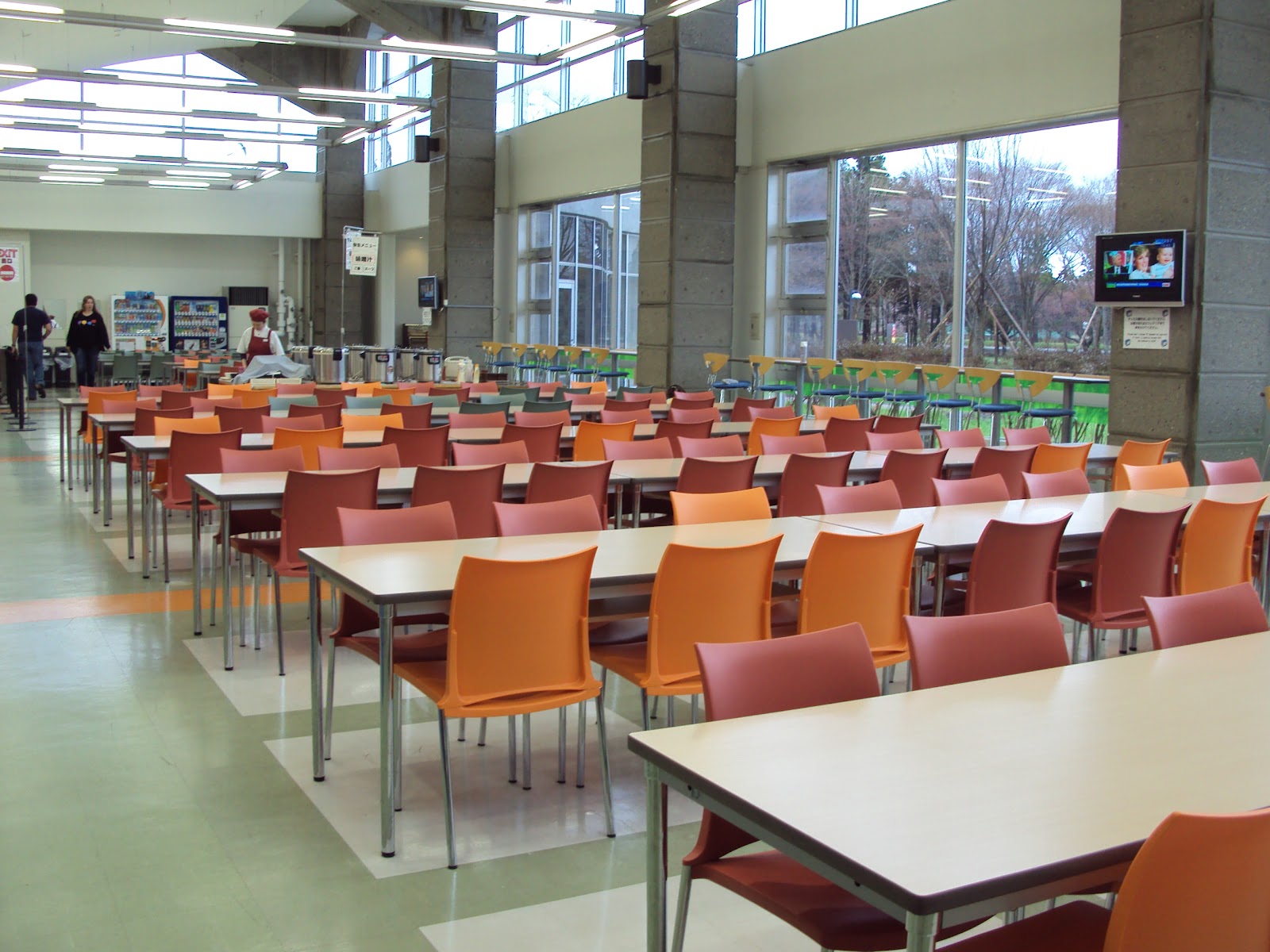
(The cafeteria where the whole freshman class and the exchange students would eat meals. Large windows allowed for delightful daydreaming on the rare chance you ate alone.)

(One, the AIU mascot. He is an Akita, the dog breed, and his name is a play on the Japanese sound for woof "wan", as well as the word 'one,' as in we are all part of one world.)


(Sakura, or cherry trees, lining one of the walkways on campus.)


(A video of the hip-hop dance club's recruiting skit. This was at an information session that told new students about the cool clubs they could join. I personally dallied in the calligraphy club, the tea ceremony club, and mainly the Japanese traditional dance club.)


Saturday, May 19, 2012

Introductions and new passions.


Hajimemashite. (Let me introduce myself.)
Guraui Kyandesu desu. (My name is Candace Graue.)
Douzo yoroshiku. (Nice to meet you.)

During my beginning Japanese class, back in my freshman year of college, we practiced self-introductions, or jikoshoukai, relentlessly. Every person was introduced to every other person a dozen times, followed by careful practicing of the Japanese bow: not too high, not too low, and with hands on the thighs for women. I had no idea that this beginner’s language course, taken on a whim, with all its introductions was introducing me to an entirely unpredicted, and therefore terrifying, direction in life.

Although I love “living in the moment” and going on spontaneous adventures, when it comes to the important, big parts of my life—career, marriage, children, lifestyle—I like to plan down to the smallest detail. I did not go into college with no idea what I wanted as a career, as many of my fellow students often do. Since my freshman year of high school I knew I wanted to be an English teacher. The more I learned about education and the issues surrounding it, the more I believed that this was my calling, my place to make a change in this world—even if it were only  through students I taught. I believed that through education, particularly English, a child’s mind could be opened to endless interests, causes, cultures, and viewpoints. They just needed the right guidance. With that passion burning in my heart, I entered college knowing my path, how to get there, and what to do in the meantime. On top of that, I knew how many kids I wanted, what their names would be, where I’d live, and what kind of house I wanted. I even knew what kinds of pets I would adopt and what I would name them. I would teach, I would live, and I would write—another passion of mine that began as early as elementary school.

But my interest in Japan and its culture and language did not diminish, and I continued to take the language courses and even studied abroad in Japan, despite the fact that these classes had no value towards my English and Education degree. Then, when I started to apply to the School of Education at my university, I came to realize that despite all my fervor for education, getting the required degree meant a lot more money and time in college than I felt was right. It meant taking on a huge amount of debt, spending an extra year and a half in school, only to go into a career that at this time is not hiring—in fact, it’s mainly cutting jobs. It was then, with a heavy heart, that I changed my Education double major to a Japanese one, feeling like I was cutting out a part of my soul for the sake of my future financial well-being.   
That’s not to say I am unhappy with a Japanese major. But after spending 6 years knowing I was going to be a teacher, suddenly not having that goal anymore left me hollow. What, I asked, would my passion be now? What would I do with a Japanese degree? Teach English in Japan? Translate? I needed that fiery motivation that kept me going through all the annoying little stuff, knowing that every small step was part of a bigger, happier picture.

Luckily, my trip to Japan for a semester and a year of pondering my future, has revealed to me a potential, new calling, one that draws on everything I believed in as a someday teacher. I still believe that people need to open their minds, to embrace curiosity, and to explore. And after traveling to Japan and a couple other countries, I think that exploration of other cultures and places of the world is particularly important. Only by exploring different ways of life can you ever truly understand yourself and the country you live in. You can never have perspective without experiencing the other side, first. Surely, this is the most important lesson I have taken from learning about and experiencing Japanese culture. Lately, I have started to think that I can still share this ideal with the world in ways other than teaching. And to be honest, I miss being tin Japan, or anywhere foreign, so deeply that is almost physically hurts in the center of my body.

So in order to explore this revised passion, I want to write about culture. Not just Japanese, but culture around the world, and even here at home. This blog will help me begin that path, and maybe find that plan I so desperately need to feel secure. Maybe I will inspire other people to go beyond their comfort zone and embrace different ways of life. This is not a travel blog, though there will be posts about travel. It is not a food blog, although I love tasting food from different countries. It is just going to be a blog about curiosity for the world—and everything that goes with it. I hope to visit many other countries as soon as I can and continue to share my experience through my writing.

Something else Japanese has taught me is that literal translations often don’t effectively communicate the same meanings. The literal translation of my opening jikoshoukai is something like “I am beginning.  I am Candace Graue. Please treat me well.” As an introduction, this translation into English isn’t much help. But for this, I believe the literal meaning works just as well. To both my future readers, and my future itself: I am beginning, please treat me well.