Showing posts with label kimono. Show all posts

Monday, February 11, 2013

Kimono Culture

As you may remember from my last post, I’m kind of a kimono fanatic. This stems from my long time fascination with geisha culture, which places particular importance on what geisha or maiko wear. So I thought I would share with you a little about kimono, and what makes them so awesome.

Kimono literally translates as “thing to wear”, but really only refers to the traditional, robe-like style of Japanese clothes you are probably familiar with. There are various types of kimono. The kind with the short sleeves that most women wear are generally just referred to as kimono, but may have specific names relating to their patterns. The beautiful, elaborate kimono with long sleeves are called furisode, and they are only worn by young women who have not married. They are often worn at the coming-of age-ceremonies that Japan holds for everyone who turns 20 in that year. (One is considered to be an adult at age 20 in Japan.) This kind of kimono is worn by maiko, apprentice geisha from Kyoto. In addition, they are used by maiko and geisha who specialize in dancing, because the longer sleeves emphasize the delicate movements. There are specific kinds of for mourning as well as marriages. There is also a summer Japanese robe called a yukata, which is thinner and easier to put on. Men’s kimono are often much simpler, usually in dark shades of blue, grey, green, and brown.


(A furisode kimono, worn by a kabuki performer. This is a photo borrowed from a friend.)


(Me and Justin at the kabuki performance. You can see how Justin's kimono is much simpler than mine. Note: My obi is a yukata obi because I didn't have time to learn how to wear the regular obi.)


Kimono are somewhat complicated to put on, and involve numerous pieces. It takes practice and specific instruction, and most people need help to put on fancier kinds of kimono. All kimono are a “one size fits all” deal, and they are made to fit through lifting and folding. Although the robe is all one piece, there are various necessary accessories that go with it. One such addition is the undergarments. Because kimono are expensive and made of fine silk, it is important to keep them as clean as possible, so they are not to be worn against bare skin. The most obvious accessory is the obi, or the belt that goes around the middle. These belts are usually very decorative and beautiful. Beneath the obi are many unseen accessories. There are a few simple cloth ties, used to hold up the hem of the kimono and to keep all the folds in place. There is also often a stiff rectangle of thin plastic to smooth out any wrinkles behind the obi. There are special collar inserts used to help keep the collar stiff. There are also various decorative accessories, such as an obi-jime, which is a thin, cord-like tie that goes around the outside of the obi, and is tied in pretty knots. The obi may be tied in a multitude of ways, each with its own particular set of steps. Luckily, a yukata is much easier to wear. You only need a couple ties underneath, and the obi is thinner and much easier to handle. However, keep in mind that yukata are very informal.


(My obi and a closeup of the wave pattern.)


(My purple yukata. You can see my obi-jime, which is pink, in the middle of my yellow obi.)


The art of pairing a kimono with its obi and obi-jime can be very deep, and it is something geisha must master. The color palate must be carefully considered. Obi should always stand out from the kimono, and not be too matching. Sometimes the obi will be the color of a small detail included in the kimono. For example, my yukata is mainly purple with pink flowers. The pink flowers have little yellow dots in the middle, so I chose a yellow obi. It stands out, but still goes with the outfit. Alternatively, obi are chosen based on pure color contrast and will often not be any shade involved in the kimono. You can think of this as choosing colors from a color wheel. Blue is on the opposite side of orange, so these colors look well together. However, Japanese aesthetics differ from our Western concepts, so the color wheel rule does not always work, but it is a good starting point. One must also consider the time of year. Seasons heavily influence which colors and patterns are appropriate to wear.

(Me and my roommate, wearing yukata. My roommate, Mai, chose a pink obi, but a green one would have worked as well, because of the green leaves in the robe.)


Kimono are very expensive. They can easily set you back a couple hundred collars, especially after buying all the accessories. However, they are also often sold to second hand stores, which is where I bought my kimono. I bought a green one that had a barely noticeable stain near the bottom for around $25, and then a beautiful orange kimono that had a tiny tear in the shoulder that had been sewn up for about $15. The problems were barely noticeable, and they were absolutely gorgeous. I also purchased a gold obi, which was another $20, I think. I haven’t bought all the necessary accessories, but I would say if you went to one of these thrift shops, you could easily buy a full set for around $100. Yukata are cheaper and often sold in complete sets, new, for around $50 or $70.


(Above: My second hand green and orange kimono, which closeups of the detailing. My gold obi works well with both of these.)


All this may sound complicated, but if you have a passion for the unique Japanese aesthetic, I highly recommend looking around to see if you can find a set you like. Even if you don’t wear them back home, they make beautiful wall pieces if you can find a way to mount them.  (Don’t use nails. Please.) My kimono and obi are definitely one of my favorite souvenirs I brought back with me, and I can’t wait for another chance to wear them.


Do you like kimono or other kinds of traditional clothing from around the world? Do you dream of owning your own complete kimono set? What kind of color combos sound appealing to you? Leave me a comment and let me know what you think!

Monday, February 4, 2013

Kakunodate: Time Travel to the Days of Samurai


The third part of our first bus trip completely made up for the slightly gloomy second stop. The last area we journeyed to is considered to be the “little Kyoto of Akita.” It's a beautiful neighborhood called Kakunodate, which was formerly a samurai town. It still retains much of the traditional architecture and style of pre-war Japan, and walking around there feels like stepping into another time. Many of the samurai houses—expansive buildings with large gardens—are open to the public as museums. One of these houses was the first place we went to. Since it was still early spring, the gardens were not that green, but it was still a beautiful house.

The first section inside the house was a collection of samurai suits of armor, swords, and other assorted weapons. This place was like a dream come true for Justin, who is a sword fanatic. This was the one time he insisted on operating my camera, taking as many pictures as possible. He admired the designs in the blades, caused by carefully controlling temperature differences in the final stages of forging. As a student of iaido, or the art of drawing one's sword, his respect for the katana is considerable, but I think he might have left some drool on the cases surrounding them. We were also impressed by the full sets of armor, in bright red and blue colors, with fierce helmets used to intimidate the opponent.

(A couple sword blades. You can see the color variation in the center of the blade. It's almost like the signature of a craftsman.)

(A set of red samurai armor. It looks like he has the face a demon on his helmet. Rawr!)


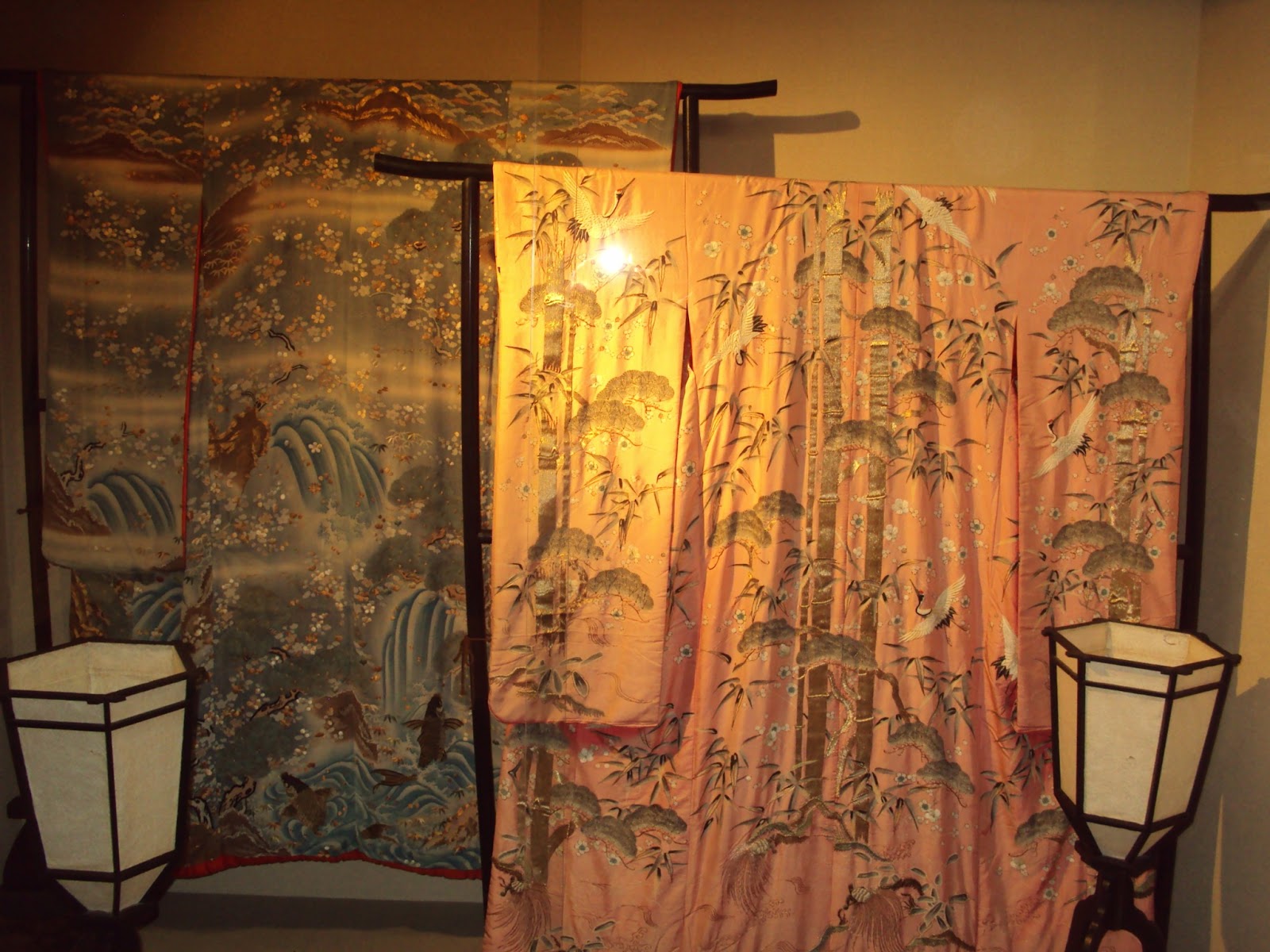
After the swords was a treat for me: two beautiful kimono as well as sleeping kimono. The normal kimono were gorgeous and intricately detailed. The sleeping kimono were fascinating; they were pretty much like Japanese Snuggies, where they covered the whole body but you slept in them like sleeping bags. They were thick and looked pretty comfy. After that we perused Japanese furniture, artwork, and pottery. There was a beautiful collection of old cameras, as well as a collection of old music players like gramophones and a Thomas Edison phonograph.

(Two beautiful kimono on display.)

(The toasty sleeping kimono.)

(My favorite of the old cameras.)

 
(Edison phonograph, surrounded by the music cylinders.)


One of my favorite parts of the museum was the doll collection. They had these beautiful flat dolls made out of cloth, as well as an assortment of extremely tiny figurines. I was especially excited to see antique versions of the hina matsuri dolls I mentioned in a previous post. In the picture below, you can see that even after years of weathering, and although her colors have faded, the old Empress doll is still as beautiful as the bright new one.

(One of the flat dolls made of cloth.)

(The antique hina matsuri empress doll. Isn't her headdress just gorgeous?)


After the first museum, we wandered into the streets. With only the pavement to mark their place in the modern day, I felt like I was walking through the Edo period down pathways of cherry blossoms. Across the way, a vender was selling soft-serve cherry blossom flavored ice cream. Trying our best to smile while the Japanese visitors stared at us, Justin and I each ordered a cone topped with ice cream the color of ballet slippers. Sakura ice cream has a very interesting taste. There is definitely the taste of cherry, but it is quite floral, with a slight tang to it. It was delicious, but at the same time each bite made me go “hmm” just because it tasted so unusual.

We visited a second museum, where we saw a complicated instrument called a shou, made of 17 bamboo pipes that is said to imitate the sound and shape of a phoenix (Wikipedia.org). It sounds sort of like a mini organ.

(The Japanese instrument called the shou).


(The first couple minutes of this video show you how the shou is played, and what it sounds like.)


I also saw tools made in the mokume gane fashion, which is a style of melding different kinds of metal together to look like wood. This style was invented by Denbei Shoami in the 17th century, and it usually includes soft metals such as gold, silver, copper, and various alloys (Wikipedia.org). Below is a beautiful jewelry box, but there were also bowls, vases, and even a matcha tea container and scoop. Incidentally, my mom and step-dad's wedding rings are also made in the mokume gane fashion.

(A mokume gane jewelry box. It looks like gold laminated wood.)


After the second museum, Justin and I wandered over the the sakura lined river that runs through Kakunodate. Although it was still cloudy, the white blossoms stretching over the water was breathtaking and tranquil. I think we were there during a cherry blossom festival, because next to the river was an array of stands. Justin and I bought some delicious meat kabobs, and watched school-age children dance in a nihon buyo performance. If you have read my post about Japanese traditional dancing, then you have seen these videos, but I'll post them again at the bottom.

(The sakura lined pathways above the river bed.)


(The sakura trees along the bank of the river.)


(Looking through blossoms.)


(Am I the kami of this beautiful tree? No just a delighted tourist!)


Kakunodate was beautiful and full of wonderful things to see. There were many shops I never got to visit, because before long we were all ushered back onto the bus to go home. I wish I could have stayed many hours more. Like Lake Tazawa, I hope to return to this lovely little town, untouched by time, and experience all its charms.

Have you ever been to Kakunodate or another town designed to preserve traditional culture? What did you think of it? Would you ever get a wedding ring made from woven metals? Do you think the shou sounds like a phoenix?

(Me by the pinkest cherry tree I saw my whole trip!)


(The young nihon buyo performers at the cherry blossom festival near the river.)


(Even younger performers. So cute!)

Monday, June 4, 2012

Nihon Buyo


My love for Japan is based mainly in the traditional aspects of its culture, which survive alongside the hyper-modern, technology dictated lifestyle of the average person. Japanese people, especially the young, have a fading interest in such traditions, and many fascinating older aspects of the culture are only kept alive through tourism and the sometimes fanatic interests of foreigners. At my school, the Japanese culture department was taught by one charmingly neurotic British guy. Even I had to do a bit of teaching myself, when many of Japanese friends didn’t know how to don a yukata (summer kimono). Luckily, a few Japanese people still continue the old fashions, such as the instructor for the nihon buyo club. In fact, nihon buyo is one tradition that is experiencing a resurgence in the Japanese population, with people taking classes for entertainment as well as health reasons.

Nihon buyo, which translates as Japanese traditional dance, is a gorgeous art form, the many faces of which have captivated my curiosity since I was young. Dating back to the Heian period (794-1192), it has changed over time and influenced or drawn influence from several other forms of dance. Many types of dance were originally designed for daily use, particularly Shinto rituals. Although many of the traditional dances people watch today are performed as both stage art and ritual, such as dances by shrine maidens, or only stage art, such as noh, nihon buyo is one of the only forms designed for the stage from the beginning. It draws elements from various other forms of dance, such as bugaku (a form of dance performed for the Imperial court), nohgaku (from noh theater), as well as a variety of folk dances that vary based on locality. Elements of nihon buyo are incorporated into kabuki buyo (dances for kabuki plays) as well as other, traditionally inspired free form dancing.
(Source: http://www.nihonbuyou.or.jp/english/about/index.html)

This kind of dancing is designed to be performed in small spaces, and thus includes small, precise, and measured movements. The use of props, such as fans or poles, is common to help accent and dramatize the moves—the long sleeves and bright coloring of the kimono or yukata also help. The dances are choreographed so that each step flows easily in the next one. Whatever position one’s foot is in, the next position can be easily reached, and the arm movements will echo the movement of the feet. There are often subtle moves that are made in preparation for future steps, such as discreetly placing one’s foot behind the other in anticipation of a fluid turn. There are also independent movements of the hands and neck, and ideally the dance should be performed with a look of placid thoughtfulness on the face. Overall, this form of dance is very refined and delicate, and for some people it may be boring. However, for those with a longer, more observational attention span, it is a beautiful form of art, full of expression in every movement of the body.

Being a fan of most traditional Japanese culture, particularly dancing, this is the first club at Akita International University that I joined. Any other club came second to it, and luckily a lot of my friends joined as well. Including my roommate, I also had friends in the club from Taiwan, Malaysia, Hungary, and the Netherlands, which made getting over any embarrassment easier. The senpai* (senior members) of the club were all very nice and helpful, and the sensei (teachers), while sometimes relentless in their practices, were easily approachable when you needed a particular step explained. I only wish we could have met more frequently, as we only met once a week. Although I was only able to perform once, the experience was one of my favorites in Japan.


The club was split into several groups; one was for the new students, two other groups containing senpai performed more advanced dances, and then our single male member, who was new as well, performed his own dance. The above picture is of my group, ready for our performance, around the one guy. The new students worked on a dance accompanied by a folk song that every Japanese person grows up knowing: Sakura Sakura. It is a song that beginners on instruments play and that little kids learn to sing for concerts. Musicians often rework the melody to try to modernize the song, keeping its place firmly rooted in the culture.
Here is a recording of the song.


Here is a translation of the lyrics:
Cherry blossoms, cherry blossoms,
Across the spring sky, as far as you can see.
Is it a mist, or is it cloud? Fragrant in the air.
Come now, come, let’s look, at last.

As you can see, it is a short song, like many folk songs, with a simple melody and simple, poetic words. I wish our recording had been as lovely as this one, but for some reason our sensei insisted on using an outdated, poor quality tape recording. I even own such a tape myself now, courtesy of my sensei as a gift at the end of my trip. What am I going to play it in, since I don’t own a tape player? No idea, but it’s a nice keepsake regardless.

As beautiful and graceful as nihon buyo is, learning it is not so delicate. The moves were difficult and sometimes felt quite awkward to my foreigner’s feet. We had to bend our knees slightly in the traditional feminine style, which made my calves and knees hurt in the beginning weeks. This was always difficult for me, and my sensei was always reminding me to bend lower. (I think it’s because I was taller than the other girls.) Our first lesson didn’t involve explanations of each individual movement, but rather was a sink-or-swim plunge that involved watching the senpai perform it once, and then giving it a go ourselves until we figured it out. The fans require a special technique to open them, which made them unreliable at times, especially since our practice fans were worn out and tended to stick every once in a while.

Eventually, after extra practicing on my own with fellow members, we finally got the dance down and were ready to perform it at a student festival near the end of the semester. I invited my host family (who I will tell you about in a later post), and they said they were really impressed, describing our performance with complicated words that were definitely out of my vocabulary! I was sad to be done with the club, but I have many pieces of memorabilia that keep the experience fresh. I have pictures and recordings of our performance, as well as a tape recording, my tabi (Japanese socks), and a pretty dancing fan that I bought for myself in the Asakusa neighborhood of Tokyo. I can even remember the dance moves, a year later. Although I am far from achieving the grace of the dancers I admire so much, it is comforting to know that despite being a foreigner, I can still perform dances with origins dating back a thousand years, and not look like a complete idiot. If you ever travel to Japan, I highly suggest going to a performance or, if you can, maybe try a lesson or two. In the meantime, here are some videos of my club's performances! I apologize for the horrible video quality; it was filmed on my dinky camera by my boyfriend in a crowded room.

(I am in the front on the right.)

(My friend from the Netherlands doing his awesome one-man dance. The difference in style is pretty cool.)

(A few senpai performing a really lovely dance with streamer fans.)

(Here are some videos of girls performing nihon buyo at a festival I saw. They're much better than me, and  the youngest ones are so cute!)


*Many people who might be familiar with common Japanese words may have a problem with me writing "senpai" instead of "sempai." I also write "tenpura" instead of "tempura," and "kanpai" instead of "kampai." Why do I do this? Because it's the correct phonetic translation. The 'sen' in 'sensei' is the same character/pronunciation as the 'sen' in 'senpai.' There is no single 'm' sound in Japanese, but there is a 'n' sound, written like: ん. It just sounds like an 'm' when next to a 'p' sound, but that doesn't reflect the transliteration properly. So, this is how it will be written in my blog, no matter what.