Showing posts with label sakura. Show all posts

Monday, February 4, 2013

Kakunodate: Time Travel to the Days of Samurai


The third part of our first bus trip completely made up for the slightly gloomy second stop. The last area we journeyed to is considered to be the “little Kyoto of Akita.” It's a beautiful neighborhood called Kakunodate, which was formerly a samurai town. It still retains much of the traditional architecture and style of pre-war Japan, and walking around there feels like stepping into another time. Many of the samurai houses—expansive buildings with large gardens—are open to the public as museums. One of these houses was the first place we went to. Since it was still early spring, the gardens were not that green, but it was still a beautiful house.

The first section inside the house was a collection of samurai suits of armor, swords, and other assorted weapons. This place was like a dream come true for Justin, who is a sword fanatic. This was the one time he insisted on operating my camera, taking as many pictures as possible. He admired the designs in the blades, caused by carefully controlling temperature differences in the final stages of forging. As a student of iaido, or the art of drawing one's sword, his respect for the katana is considerable, but I think he might have left some drool on the cases surrounding them. We were also impressed by the full sets of armor, in bright red and blue colors, with fierce helmets used to intimidate the opponent.

(A couple sword blades. You can see the color variation in the center of the blade. It's almost like the signature of a craftsman.)

(A set of red samurai armor. It looks like he has the face a demon on his helmet. Rawr!)


After the swords was a treat for me: two beautiful kimono as well as sleeping kimono. The normal kimono were gorgeous and intricately detailed. The sleeping kimono were fascinating; they were pretty much like Japanese Snuggies, where they covered the whole body but you slept in them like sleeping bags. They were thick and looked pretty comfy. After that we perused Japanese furniture, artwork, and pottery. There was a beautiful collection of old cameras, as well as a collection of old music players like gramophones and a Thomas Edison phonograph.
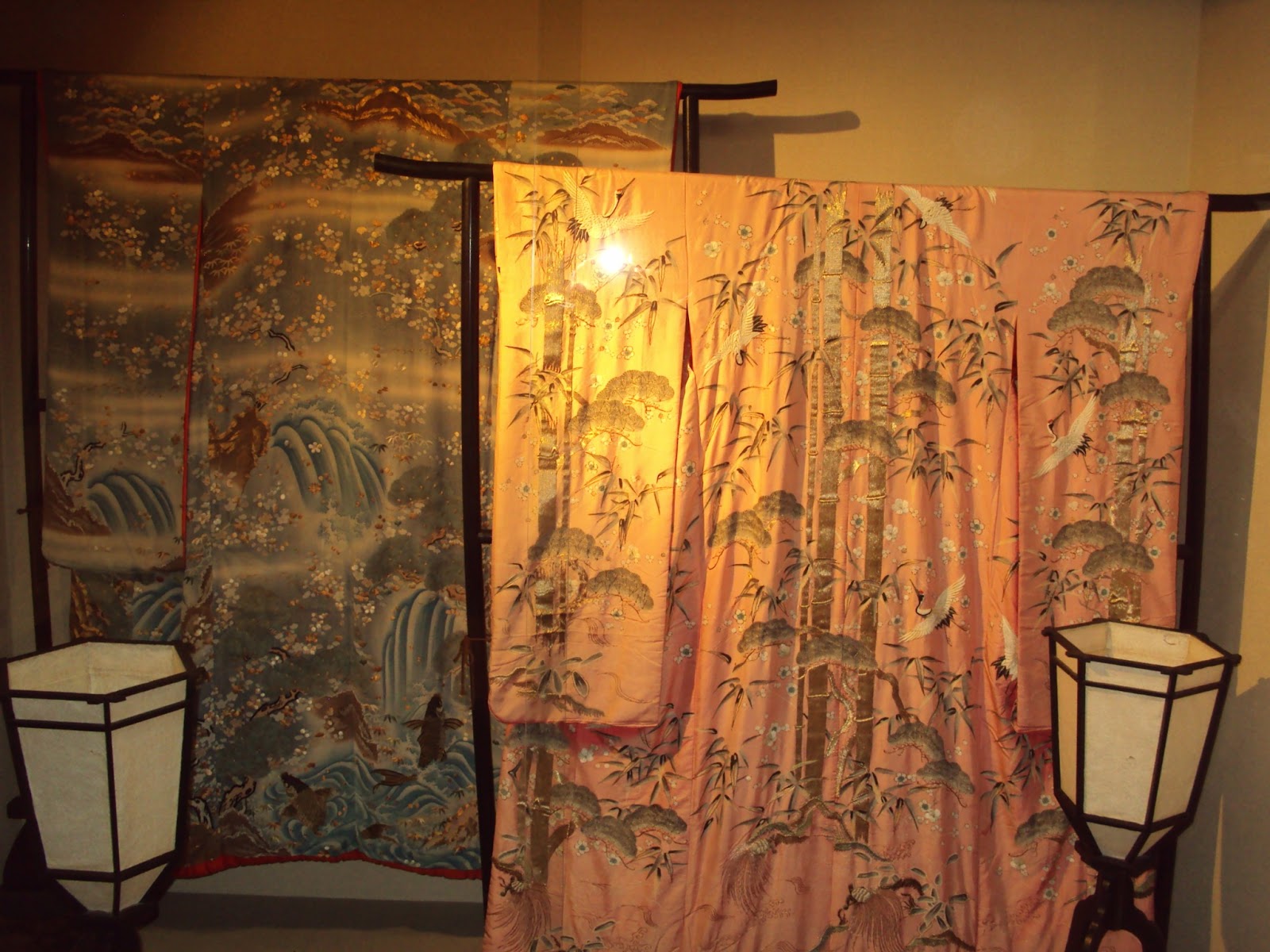
(Two beautiful kimono on display.)

(The toasty sleeping kimono.)

(My favorite of the old cameras.)

 
(Edison phonograph, surrounded by the music cylinders.)


One of my favorite parts of the museum was the doll collection. They had these beautiful flat dolls made out of cloth, as well as an assortment of extremely tiny figurines. I was especially excited to see antique versions of the hina matsuri dolls I mentioned in a previous post. In the picture below, you can see that even after years of weathering, and although her colors have faded, the old Empress doll is still as beautiful as the bright new one.

(One of the flat dolls made of cloth.)

(The antique hina matsuri empress doll. Isn't her headdress just gorgeous?)


After the first museum, we wandered into the streets. With only the pavement to mark their place in the modern day, I felt like I was walking through the Edo period down pathways of cherry blossoms. Across the way, a vender was selling soft-serve cherry blossom flavored ice cream. Trying our best to smile while the Japanese visitors stared at us, Justin and I each ordered a cone topped with ice cream the color of ballet slippers. Sakura ice cream has a very interesting taste. There is definitely the taste of cherry, but it is quite floral, with a slight tang to it. It was delicious, but at the same time each bite made me go “hmm” just because it tasted so unusual.

We visited a second museum, where we saw a complicated instrument called a shou, made of 17 bamboo pipes that is said to imitate the sound and shape of a phoenix (Wikipedia.org). It sounds sort of like a mini organ.

(The Japanese instrument called the shou).


(The first couple minutes of this video show you how the shou is played, and what it sounds like.)


I also saw tools made in the mokume gane fashion, which is a style of melding different kinds of metal together to look like wood. This style was invented by Denbei Shoami in the 17th century, and it usually includes soft metals such as gold, silver, copper, and various alloys (Wikipedia.org). Below is a beautiful jewelry box, but there were also bowls, vases, and even a matcha tea container and scoop. Incidentally, my mom and step-dad's wedding rings are also made in the mokume gane fashion.

(A mokume gane jewelry box. It looks like gold laminated wood.)


After the second museum, Justin and I wandered over the the sakura lined river that runs through Kakunodate. Although it was still cloudy, the white blossoms stretching over the water was breathtaking and tranquil. I think we were there during a cherry blossom festival, because next to the river was an array of stands. Justin and I bought some delicious meat kabobs, and watched school-age children dance in a nihon buyo performance. If you have read my post about Japanese traditional dancing, then you have seen these videos, but I'll post them again at the bottom.

(The sakura lined pathways above the river bed.)


(The sakura trees along the bank of the river.)


(Looking through blossoms.)


(Am I the kami of this beautiful tree? No just a delighted tourist!)


Kakunodate was beautiful and full of wonderful things to see. There were many shops I never got to visit, because before long we were all ushered back onto the bus to go home. I wish I could have stayed many hours more. Like Lake Tazawa, I hope to return to this lovely little town, untouched by time, and experience all its charms.

Have you ever been to Kakunodate or another town designed to preserve traditional culture? What did you think of it? Would you ever get a wedding ring made from woven metals? Do you think the shou sounds like a phoenix?

(Me by the pinkest cherry tree I saw my whole trip!)


(The young nihon buyo performers at the cherry blossom festival near the river.)


(Even younger performers. So cute!)

Tuesday, June 12, 2012

Parties under the cherry blossoms


When I went to Japan, spring was just spreading over the island nation. Of course, Japan is probably most famous for its beautiful sakura, or cherry blossoms, that bloom across the country like a pink wave. They begin as early as the end of January in the far south, and finish as late as May in the northern island of Hokkaido. In Akita, the cherry blossoms arrived in late April, just after I got there, as if an earthquake-shattered Japan was donning her best kimono to distract me from the shambles around her. Cherry blossoms bloom quite suddenly, with entire trees bursting into cloud-like fluff seemingly overnight. Just as quickly as they appear, they fade within a couple weeks, gently sprinkling their petals over the ground like tears until they are spent and green leaves has taken their place.  

The Japanese love sakura more than any other flower. It has been depicted in paintings, lauded in poems, and glorified as the national flower. The sakura mark the 100 yen coin. It is a popular girl’s name, Sakura have even been made into sweets. The blooming of the cherry tree is both a happy and melancholic event. As the harbingers of spring, it represents renewal, harmony, growth, and beauty. However, their rapid disappearance carries symbols of death, impermanence, and letting go. This duality is a common theme in the Japanese religion*, especially the Buddhist elements.

One of the positive associations with the sakura is the tradition of hanami, or flower viewing. “Flower viewing” is a literal translation, although there is no real, concise English equivalent that communicates the same concept. Hanami is hanami. It is the tradition of going out with family or friends to sit under the blooming cherry trees to watch and appreciate their beauty. It is a chance to feel a sense of oneness with nature. It is also a party, often including lots of drinking, picnic food, and rowdy behavior.

The hanami has a long history in Japan. Although records of the gatherings are found in Japan’s first historical texts, such as the Nihon Shoki, dating them as far back as the 3rd century, the tradition is said to have really begun in the Nara Period (710-794), with its full form and sakura-only focus beginning in the Heian Period (794-1185). Like many beloved Japanese traditions, it began as an activity for the wealthy and high class, and eventually found its way into the hearts of the common folk. It is so firmly rooted in the culture that it is enjoyed by nearly everyone in the nation, and news stations even have daily reports in the spring to show exactly where the sakura are beginning to bloom. Schools take their students on hanami outings, families crowd the parks with their children, eating obento (packed lunches) beneath the shade, and friends gather together to drink and enjoy the brief time of the cherry tree in full bloom. The tradition of hanami communicates the same sentiments of the sakura, perhaps even more so. It especially emphasizes the idea of “ichi go, ichi e,” which means “One moment, one encounter.” English speakers may be more familiar with the equivalent of “carpe diem,” “seize the day,” or “live in the moment.” The sakura are a brief beauty, and the hanami is the best way to enjoy them while they last. (http://thinkjapanblog.com/sakura-hanami-flower-viewing.html)

In a culture where many people are disregarding their heritage and old traditions, hanami and the love of sakura is one example of a tradition that continues to remain strong even in the face of constant technological development, busy work schedules, and endless distractions. Even the most overloaded salary man, the busiest housewife, and the most absorbed gaming or texting teen gather together to enjoy an afternoon of hanami. Hanami and sakura are the essence of Japan and the Japanese people.

For someone from dry Colorado, the sheer number of cherry trees and the culture surrounding them was completely astounding. I spent a lot of time trying to take as many pictures and videos of the blooms as I could, always aware of their ephemeral nature. I watched the gradual invasion of green with apprehension, despairing at the scattering dead but still beautiful petals on the ground.

 I delighted at discovering how many different kinds of cherry trees were on the AIU campus. Below, you can see a small sampling I collected. The shapes are so beautiful and distinct, and yet they all carry the same emotional symbolism. Someday, I will do a small, watercolor painting of this shot. According to Japan-Guide.com, there are over 100 kinds of cherry trees in Japan. The different kinds range in the number of petals, their general shape, the way they hang on the tree, their color (white to bright pink, as well as yellow), and the location and length of their blooming period. Some of them are wild, but most of them are cultivated. I think the three below are called imose, soushunzakura, and akebono, from left to right. (Those are only my guesses!) (http://www7b.biglobe.ne.jp/~mainn/sakura/sakura.html)


The scattered trees around campus were beautiful, but there is nothing like seeing dozens of trees clustered together. My trip to a town called Kakunodate was the perfect chance to see that the beauty of sakura grows exponentially with each additional tree.


 Their splendor made the rainy days of early spring as far from dreary as possible. And yet, I did not feel the rumored sadness when the last petal fell. The lush green that had replaced the pink was just as gorgeous. Perhaps I am not familiar enough with their passing, or the intense heat of the Japanese summers, but I felt only invigoration from the blooming of the sakura, and the green summer with its new flowers continued the inspiration. I think I focused on the symbolism of rebirth and somehow missed the melancholy meaning of death. All I know is that the memory of those beautiful pink and white clouds springs to my mind’s eye with ease, the feel of the petals lingers of my fingertips, and the curious floral yet fruity taste of sakura ice cream still dances on my tongue. The sakura may be evanescent, but the delight of my memories is constant.


Below are some of the best pictures of sakura I (or my boyfriend) took while in Japan.

(Me by the pinkest sakura I could find.)

(A pathway near the river at Kakunodate.)

(The white cherry blossoms lining the river. I wish it had been sunnier.)


(A set of three pictures from a particularly scenic rest area on a bus trip. Sakura under a blue sky are so beautiful!)

(Sakura petals on the ground.)

The background of my blog is another picture I took, up close. Can you spot the spider I also managed to photograph?

_________________________________________________________________________________


*Many people distinguish between Shinto and Buddhism as Japan’s major religions; however they have become so intricately linked over the centuries that they are almost a single, uniquely Japanese religion.