Showing posts with label festival. Show all posts

Monday, February 4, 2013

Kakunodate: Time Travel to the Days of Samurai


The third part of our first bus trip completely made up for the slightly gloomy second stop. The last area we journeyed to is considered to be the “little Kyoto of Akita.” It's a beautiful neighborhood called Kakunodate, which was formerly a samurai town. It still retains much of the traditional architecture and style of pre-war Japan, and walking around there feels like stepping into another time. Many of the samurai houses—expansive buildings with large gardens—are open to the public as museums. One of these houses was the first place we went to. Since it was still early spring, the gardens were not that green, but it was still a beautiful house.

The first section inside the house was a collection of samurai suits of armor, swords, and other assorted weapons. This place was like a dream come true for Justin, who is a sword fanatic. This was the one time he insisted on operating my camera, taking as many pictures as possible. He admired the designs in the blades, caused by carefully controlling temperature differences in the final stages of forging. As a student of iaido, or the art of drawing one's sword, his respect for the katana is considerable, but I think he might have left some drool on the cases surrounding them. We were also impressed by the full sets of armor, in bright red and blue colors, with fierce helmets used to intimidate the opponent.

(A couple sword blades. You can see the color variation in the center of the blade. It's almost like the signature of a craftsman.)

(A set of red samurai armor. It looks like he has the face a demon on his helmet. Rawr!)


After the swords was a treat for me: two beautiful kimono as well as sleeping kimono. The normal kimono were gorgeous and intricately detailed. The sleeping kimono were fascinating; they were pretty much like Japanese Snuggies, where they covered the whole body but you slept in them like sleeping bags. They were thick and looked pretty comfy. After that we perused Japanese furniture, artwork, and pottery. There was a beautiful collection of old cameras, as well as a collection of old music players like gramophones and a Thomas Edison phonograph.
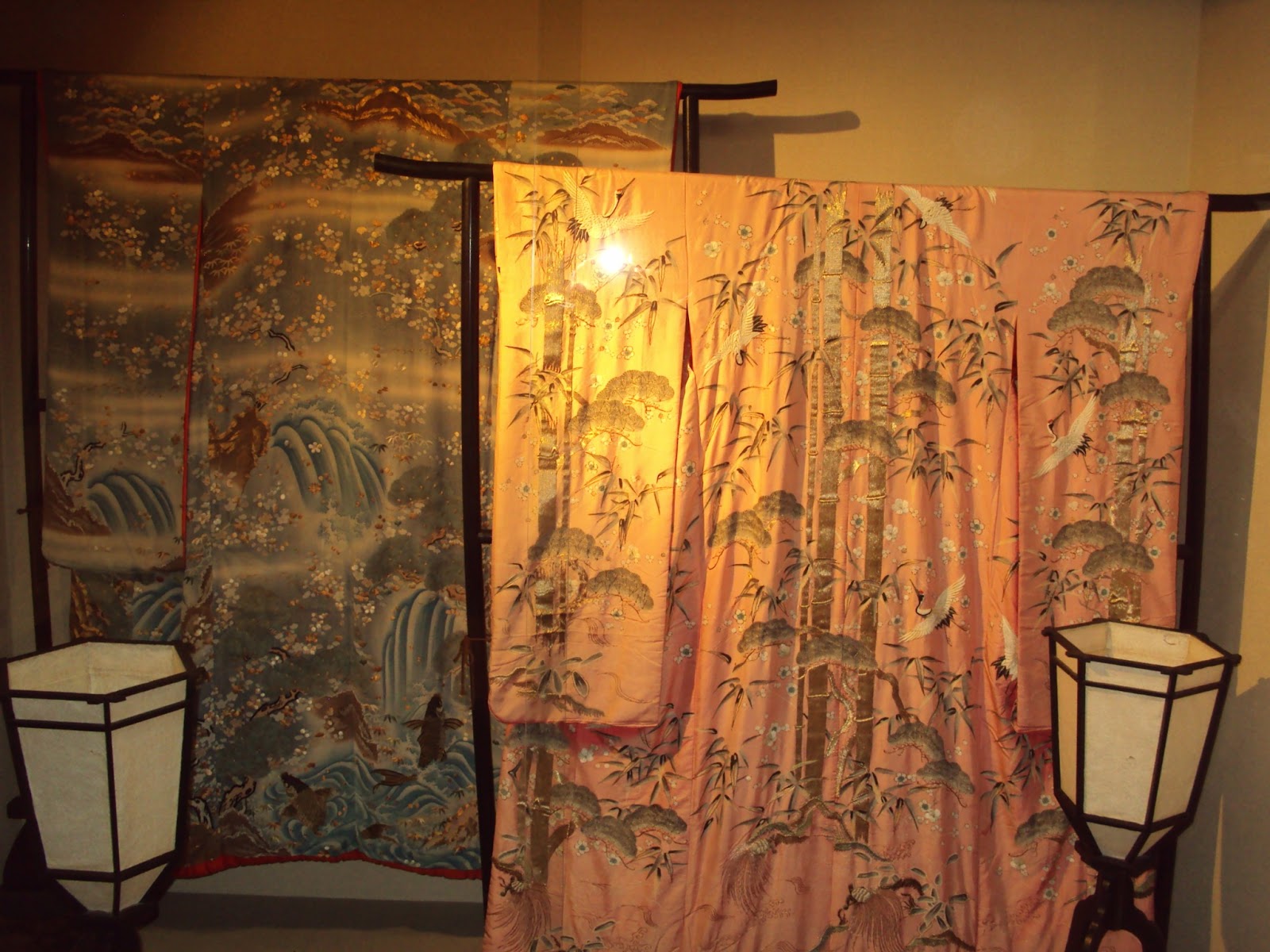
(Two beautiful kimono on display.)

(The toasty sleeping kimono.)

(My favorite of the old cameras.)

 
(Edison phonograph, surrounded by the music cylinders.)


One of my favorite parts of the museum was the doll collection. They had these beautiful flat dolls made out of cloth, as well as an assortment of extremely tiny figurines. I was especially excited to see antique versions of the hina matsuri dolls I mentioned in a previous post. In the picture below, you can see that even after years of weathering, and although her colors have faded, the old Empress doll is still as beautiful as the bright new one.

(One of the flat dolls made of cloth.)

(The antique hina matsuri empress doll. Isn't her headdress just gorgeous?)


After the first museum, we wandered into the streets. With only the pavement to mark their place in the modern day, I felt like I was walking through the Edo period down pathways of cherry blossoms. Across the way, a vender was selling soft-serve cherry blossom flavored ice cream. Trying our best to smile while the Japanese visitors stared at us, Justin and I each ordered a cone topped with ice cream the color of ballet slippers. Sakura ice cream has a very interesting taste. There is definitely the taste of cherry, but it is quite floral, with a slight tang to it. It was delicious, but at the same time each bite made me go “hmm” just because it tasted so unusual.

We visited a second museum, where we saw a complicated instrument called a shou, made of 17 bamboo pipes that is said to imitate the sound and shape of a phoenix (Wikipedia.org). It sounds sort of like a mini organ.

(The Japanese instrument called the shou).


(The first couple minutes of this video show you how the shou is played, and what it sounds like.)


I also saw tools made in the mokume gane fashion, which is a style of melding different kinds of metal together to look like wood. This style was invented by Denbei Shoami in the 17th century, and it usually includes soft metals such as gold, silver, copper, and various alloys (Wikipedia.org). Below is a beautiful jewelry box, but there were also bowls, vases, and even a matcha tea container and scoop. Incidentally, my mom and step-dad's wedding rings are also made in the mokume gane fashion.

(A mokume gane jewelry box. It looks like gold laminated wood.)


After the second museum, Justin and I wandered over the the sakura lined river that runs through Kakunodate. Although it was still cloudy, the white blossoms stretching over the water was breathtaking and tranquil. I think we were there during a cherry blossom festival, because next to the river was an array of stands. Justin and I bought some delicious meat kabobs, and watched school-age children dance in a nihon buyo performance. If you have read my post about Japanese traditional dancing, then you have seen these videos, but I'll post them again at the bottom.

(The sakura lined pathways above the river bed.)


(The sakura trees along the bank of the river.)


(Looking through blossoms.)


(Am I the kami of this beautiful tree? No just a delighted tourist!)


Kakunodate was beautiful and full of wonderful things to see. There were many shops I never got to visit, because before long we were all ushered back onto the bus to go home. I wish I could have stayed many hours more. Like Lake Tazawa, I hope to return to this lovely little town, untouched by time, and experience all its charms.

Have you ever been to Kakunodate or another town designed to preserve traditional culture? What did you think of it? Would you ever get a wedding ring made from woven metals? Do you think the shou sounds like a phoenix?

(Me by the pinkest cherry tree I saw my whole trip!)


(The young nihon buyo performers at the cherry blossom festival near the river.)


(Even younger performers. So cute!)

Saturday, January 5, 2013

Hina Matsuri


Hello, my long awaiting readers (though you may be few). After a terribly long absence, I am finally back, with a new blog post. First, I would like to apologize for the delay. I know that, personally, it drives me crazy when a favorite blogger or comic artist suddenly disappears and doesn’t post anything new for months or sometimes years. I never wanted to be that person, but in the end my personal life just became too overwhelming to maintain posts. Of course there was university, but there was also the stress of a new job, as well as my boyfriend’s hip surgery, which rendered him completely helpless for a long time. A few other incidental stresses worked together with these major ones to sap not only my motivation to write, but also, quite honestly, my happiness. Only recently have I overcome a bout of mild depression, and I am trying my best to keep up my spirits. I really think devoting myself again to this blog will help. Writing has always been a sweet escape from the stresses of daily life, but reminiscing about fun times abroad is also a nice reminder that I have a good life worth appreciating.


So without further ado, I would like to return you to the tales of my trip to Japan, to talk about one of my favorite Japanese cultural traits: matsuri, or festivals. Japan is really a country of festivals. There are so many, that it would be impossible to count. The most common kind of festival is the kind often seen in anime shows. These are local festivals that celebrate some deity or another, and usually include cordoned off streets filled with stalls selling everything from finger foods to masks and fans. There are also often carnival-style games, floats, and street performers. In a later post, I will describe my own experience with such a celebration.


 Some festivals are celebrated nation-wide, such as Obon, a festival for one’s ancestors, Tanabata, a wish-making festival, or kodomo no hi, a celebration of children. In some regions the dates and various traditions of these festivals vary, but they are all observed with at least a few similar customs. During Obon, family gets together to share in a feast and remember relatives, as well as visit family graves and place food before the stones, which are often pretty sculptures made of sugar. There is also usually a dance, which varies by region, to honor the dead. At the end, paper lanterns are floated down rivers to carry the spirits back to the realm of the dead. (Wikipedia.org).


Tanabata is a festival which celebrates the meeting of two lover deities, Orihime and Hikoboshi, embodied in two constellations, which are, in the West, Vega and Altair, respectively (Wikipedia.org). These two lovers are only able to meet once a year because of the distance separating them in the sky. During this meeting, people write wishes to the gods on pieces of paper and then hang them from a strip of bamboo (Wikipedia.org).


Kodomo no hi, or children’s day, is exactly what it sounds like: a day to celebrate children. The tradition is to raising carp-shaped flags called koi no bori, one for each child. The different colors and sizes designate age. Originally, this day was only for boys, and only the male children were celebrated, but it was changed in 1948 and was deemed to celebrate all children. However, the festival remains mostly geared towards boys (Wikipedia.org).


Luckily, girls get their festival, as well. This festival, called hina matsuri, was the first festival I encountered in Japan. Hina matsuri translates into “doll festival.” The origins behind this festival stem from the belief that dolls contained real spirits, which could turn malignant if not respected (Wikipedia.org). To this day, many Japanese people carry the suspicion that dolls having feelings and must not be insulted.  However, the main purpose of the holiday is to display a specific set of dolls and admire their beauty. The dolls depict an emperor and empress, as well as their entourage, including ladies-in-waiting, guards, musicians, and even their luggage and pack animal. These dolls are set out in a specific order on a stepped platform covered in red cloth. A complete set is often very expensive, and is usually a family heirloom, passed on from mother to daughter. (If any of you have seen the original seasons of Pokemon, these dolls are the dolls that Misty and Jesse compete to win in a particular battle competition.)


AIU had a set of dolls displayed in a special tatami room. People were welcome to come and look at it, though at the time I was still new to the school and too timid to inspect the dolls closely. Fortunately, when I went to go look with a friend, some school officials and the lady who had generously lent AIU the dolls were preparing to pack them up (the festival was at an end). They invited me and my friend to help put them away, and allowed me to take a few pictures before they went back to sleep in their boxes.

I was most struck by the amazing attention to detail that went into the dolls. As you can see in the photos, the clothes are absolutely gorgeous, with tiny details that seem like whispers from a bygone age of craftsmanship. The tea-set is so detailed that the whisk for the matcha powder looks practically usable. I wasn’t sure what I expected the dolls to be made of (perhaps porcelain) but they were actually made of high quality plastic, which made them feel so light and delicate in my hands. The set even included two trees, as well as two cherry blossom-print lanterns which would turn on if plugged in. I felt so lucky to have the chance to handle the dolls and appreciate them up close, and I have since become determined to own a set myself someday. I will celebrate this beautiful matsuri with my future daughter.

(The Emperor in his regal kimono. I love the pattern on his kimono and also his hat.)


(The Empress with her delicately painted fan. This fan was only a bit bigger than a quarter, and yet not a line on that heron is misplaced.)


(One of the royal attendants. This one is in a sitting pose, cradling a small stand with two tea cups.)

(The royal tea set, complete with hot water in the center, a ladle on the right, and a tiny whisk on the left.)


I was delighted to have experienced this festival, as well as a few others, during my stay in Japan. If you are interested in catching a few festivals yourself, I recommend traveling to Japan during the summer months, when festival saturation is at its highest. It seems like you cannot go a single week without a local festival breaking out (often as local as individual neighborhoods), and many of the major, national ones occur in the summer, as well. Hina matsuri is in March, Kodomo no hi is in May, Tanabata is in July, and Obon is in August. Of course, there are many other festivals during every part of the year, but summertime is like one big celebration, when hard-working students and salary-men and women escape the pressures of responsibility to don a yukata and watch fireworks.